

Choose a beginner chemical peel course with supervised practice and an observed treatment assessment - not just a certificate. Online study can cover theory, but beginners also need hands-on instruction before treating clients.
The choice comes down to 3 formats: online, in-person and hybrid. Compare the lessons, demonstrations, instructor feedback, practical hours, assessment and total cost in Canadian dollars.
Quick Comparison
| What to compare | Online | In-person | Hybrid |
|---|---|---|---|
| Theory and demonstrations | Online lessons; recorded or live demonstrations | Classroom lessons and live demonstrations | Online theory plus in-person instruction |
| Practice and feedback | Often limited; check what requires separate training | Supervised model treatments and feedback | Hands-on sessions alongside online study |
| Assessment | May rely on quizzes or videos | May include an observed treatment | Check that an observed treatment is required |
| Schedule and cost | Check live-session times, supplies and separate practical fees | Fixed dates; include supplies, travel and missed work | Flexible theory, fixed practical dates and possible travel |
Before enrolling, confirm prerequisites, instructor qualifications and how each learner is assessed on skin checks, peel selection, application, stopping safely, aftercare and records. A certificate does not grant legal permission or insurance coverage. Provincial or territorial rules, product restrictions and written insurer approval need separate checks.
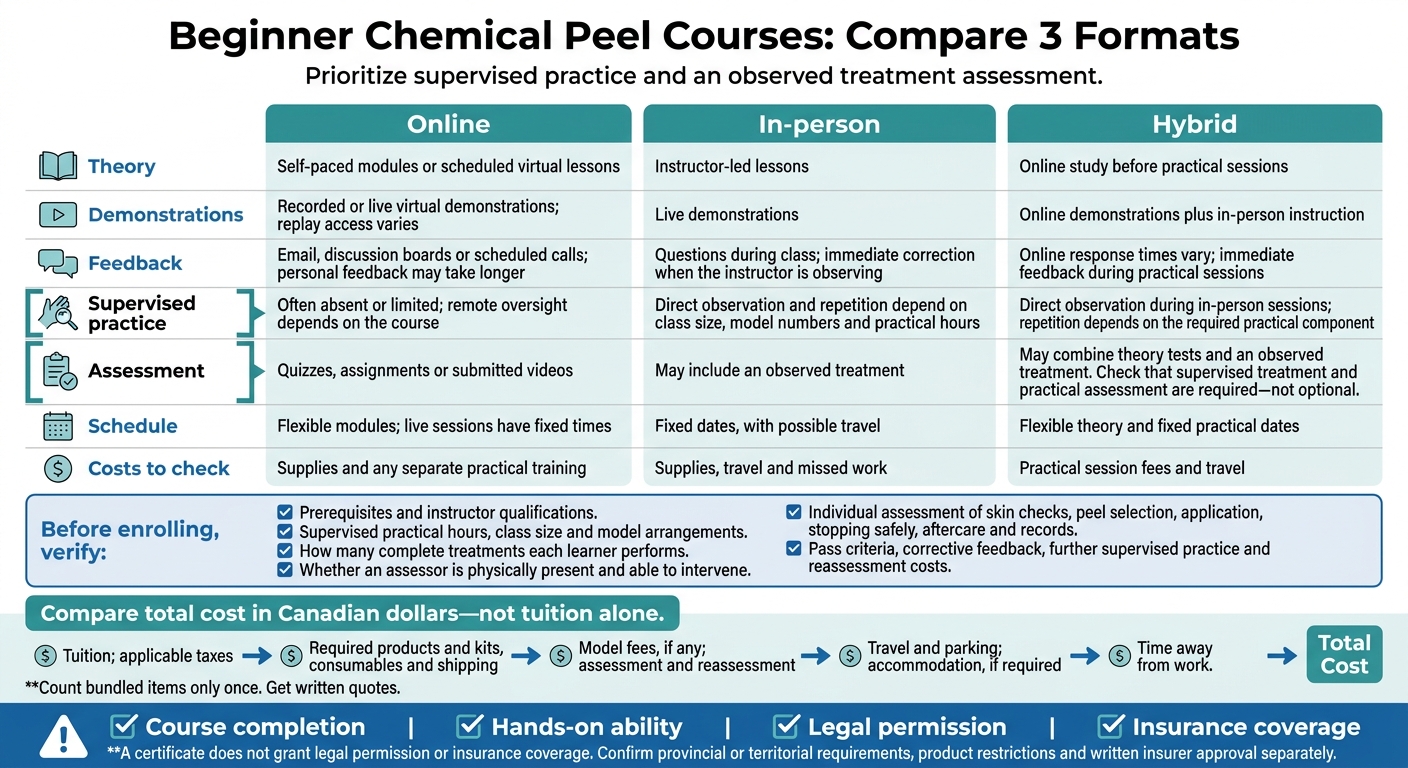
Beginner Chemical Peel Courses: Compare 3 Formats
Online vs. In-Person Learning: What to Expect
Each format offers a different mix of theory, feedback and supervised practice. Use this comparison to see what’s included - and what you may need to arrange yourself.
| What to compare | Online | In-person | Hybrid |
|---|---|---|---|
| Theory | Self-paced modules or scheduled virtual lessons | Instructor-led lessons | Online study before practical sessions |
| Demonstrations | Recorded or live virtual demonstrations; replay access varies | Live demonstrations | Online demonstrations plus in-person instruction |
| Questions and feedback | Email, discussion boards or scheduled calls; quiz results may be immediate, but personal feedback may take longer | Questions during class; immediate correction when the instructor is observing | Online response times vary; immediate feedback during practical sessions |
| Supervised practice and oversight | Often absent or limited; remote oversight depends on the course | Direct observation and repetition depend on class size, model numbers and practical hours | Direct observation during in-person sessions; repetition depends on the required practical component |
| Assessment | Quizzes, assignments or submitted videos | May include an observed treatment | May combine theory tests and an observed treatment |
| Scheduling | Flexible modules; live sessions have fixed times | Fixed dates, with possible travel | Flexible theory and fixed practical dates |
| Total cost | Include supplies and any separate practical training | Include supplies, travel and missed work | Include practical session fees and travel |
Online Courses: Theory and Recorded Demonstrations
Look for coverage of anatomy, peel chemistry, contraindications, consent, infection prevention, application steps, aftercare and adverse reaction management. Check that the course covers the formulations and strengths you plan to use.
Recorded demonstrations help with review, but they don’t replace live correction of product quantity, application control or responses in the skin. Ask how long instructors take to answer questions and whether practical training is available.
In-Person Courses: Practice and Immediate Feedback
Ask how much time you’ll spend treating models, how large the class is, the instructor-to-learner ratio and how many complete treatments each learner performs.
Sessions should cover instructor-led theory, live demonstrations, consultation and consent practice, product preparation, model treatments and an observed assessment. Feedback should address product handling, application control, timing, client communication and responses in the skin. Confirm attendance dates before budgeting for transport, accommodation and missed work.
Hybrid Courses: Online Study and In-Person Practice
A hybrid course works only when supervised treatment and practical assessment are required - not optional. Ask which products and peel strengths the practical sessions cover, how many complete treatments each learner performs and whether an instructor observes every learner. Check whether further practice or reassessment is available, too.
The format alone doesn’t establish readiness. Learners must also demonstrate skills that meet the training provider’s requirements and applicable insurer, workplace and provincial or territorial requirements.
Total Costs: Tuition, Supplies and Travel
Before comparing prices, confirm that each fee includes the hands-on training you need. Get written price quotes covering theory, supplies, supervised practice and assessment in Canadian dollars. Count bundled items only once, and check whether taxes, practical assessment and reassessment are included.
| Budget item | Online | In person | Hybrid |
|---|---|---|---|
| Tuition | Course fee | Course fee | Combined fee, or theory plus practical fee |
| Applicable taxes | Confirm taxable charges | Confirm taxable charges | Confirm taxable charges |
| Required products and kits | Kit, consumables and shipping | Kit and consumables | Kit, consumables and shipping |
| Model fees | Model costs, if any | Model costs, if any | Practical-session model costs, if any |
| Assessment and reassessment | Practical assessment and reassessment fees | Practical assessment and reassessment fees | Practical assessment and reassessment fees |
| Travel | Any practical-training trips | Transportation and parking | Travel for practical sessions |
| Accommodation | If practical training requires it | Overnight stays, if required | Overnight stays, if required |
| Time away from work | Study and practical attendance | Scheduled attendance and travel | Online study, practical attendance and travel |
| Total budget in CAD | Sum all applicable costs above | Sum all applicable costs above | Sum all applicable costs above |
sbb-itb-c911f39
Hands-On Skills to Show Before Treating Clients
When comparing course formats, look at the skills each course assesses in person. Make supervised practice and an observed practical assessment your deciding factor. The instructor should assess both your decisions and your technique, using clear safety criteria and giving feedback before reassessment.
Consultation, Skin Assessment and Peel Selection
An instructor should watch you review medical and treatment history, screen for contraindications, assess the skin, obtain consent and set client expectations. Explain your peel choice using the manufacturer’s directions - not concentration alone - and know when to postpone treatment or refer the client.
Assessment must cover pigmentation risks across skin tones, including a history of post-inflammatory hyperpigmentation. When patch testing is required, document the result and assess the response. A patch test does not guarantee safety. Apply that same care to decisions during treatment.
Preparation, Application and When to Stop
Hands-on assessment should cover hygiene, cleansing and degreasing where required, protection of sensitive areas, solution handling, controlled application and timing. It should also test how you monitor skin response and discomfort.
Stopping safely matters more than finishing. Learners must recognise excessive irritation or unexpected changes and follow the product-specific instructions for removal or neutralization. Simulated scenarios should test responses to eye exposure, blistering or breathing symptoms. Knowing when and how to stop also guides aftercare.
Aftercare, Adverse Reactions and Treatment Records
Explain recovery, skincare restrictions, sun protection and follow-up in plain language. Then ask the client to repeat the instructions back. Assessment should test whether you can distinguish expected effects from warning signs, including worsening pain, swelling, blisters, oozing or pus. It should also check that you know when to seek medical help rather than treat beyond your scope.
Before treating clients independently, complete a treatment record that includes consultation findings, consent, product name and concentration, batch details where available, application notes, client response, aftercare and follow-up.
Rehearse the emergency response: locate safety information, notify the supervisor, contact medical help and document escalation. A complete record and a safe referral decision count toward readiness to practise, not just a finished application.
Assessment, Certificates and Canadian Practice Rules
Course completion, hands-on ability, legal permission and insurance coverage are separate checks. A certificate does not automatically satisfy all four. Requirements depend on your province or territory, professional role, facility and planned treatment - not just whether you studied online or in person.
Online Tests vs. Observed Treatments
| Assessment | Skills assessed | Main limitation | Evidence of safe practical performance |
|---|---|---|---|
| Online quiz | Ingredients, contraindications and safety theory | Tests knowledge, not technique | A score, not proof of treatment ability |
| Written assignment | Treatment planning and reasoning | Cannot show manual skills | Written evidence of understanding |
| Case study | Risk assessment and treatment decisions | Hypothetical details may miss actual skin findings | Evidence of decision-making |
| Submitted video | Set-up, hygiene, product handling and technique | Assessor may not be able to intervene immediately or see every safety detail | Recorded performance; may not meet practical-training requirements |
| Directly observed treatment | Technique, timing and real-time decisions | Requires a qualified assessor, suitable model and facility | Signed assessment against defined criteria |
Ask for documented performance assessment, not proof of attendance alone. Confirm whether “practical assessment” means an uploaded recording or an assessor who is physically present and able to intervene. Videos can support observation, but should not automatically replace it. Keep your assessment result, assessor comments and practical record with your training documents.
Entry Requirements and Instructor Qualifications
Check prerequisites before paying. “beginner” may still mean someone with an esthetics diploma or professional registration. Request the instructor’s relevant credentials, chemical-peel training, current treatment experience and teaching experience.
Ask about learning outcomes, supervised practical hours, model arrangements, class size, pass criteria, reassessment costs and post-course support. If you do not meet the required standard, will you receive corrective feedback and further supervised practice?
Request sample certificate wording as well. It should state what you completed and what was assessed, without suggesting that it grants a government licence or unrestricted permission to perform peels.
Scope of Practice, Insurance and Peel Restrictions
Confirm current requirements with your provincial or territorial regulator, local public-health authority, employer and facility. Check licensing where applicable, premises requirements, and any supervision, delegation or medical-director conditions. Alberta includes chemical peels within its personal-services framework and requires businesses to notify Alberta Health Services before offering services.
Get written confirmation from your insurer that coverage includes your professional status, exact peel products and strengths, treatment setting and model practice. General commercial liability may not replace professional-liability coverage.
Check the product’s Canadian classification and professional-use instructions before choosing training or buying supplies. Acid percentage alone does not determine depth or risk: pH, formulation, contact time and skin condition also matter. Deeper or higher-strength peels may require additional qualifications or medical supervision.
Health Canada advises that high-concentration or low-pH in-office peels are best performed or supervised by dermatologists or plastic surgeons. A private course certificate cannot expand your legal scope or override an insurance exclusion.
Conclusion: Pair Theory With Supervised Practice
Choose a format that tests your hands-on skills, pairing theory with supervised peel application. It should assess you individually on safe peel selection, controlled application and knowing when to stop.
Before treating clients independently, keep your practical sign-off, protocols and insurance confirmation together.
FAQs
How can I verify a course’s practical training quality?
Look for courses that assess your skills, not just track module completion. This could include supervised practice or live demonstrations reviewed by an instructor. Before enrolling, check that the syllabus covers skin anatomy, safety and infection control. Ask how the course tests your understanding - for example, through written exams or case studies.
Save your certificate, manual and assessment results as soon as you finish. Access to the online portal may expire within 90 days to 6 months.
What if I need more practice after passing?
Passing a course doesn’t always mean you’re ready to treat clients on your own. If you need more practice, arrange additional supervised, hands-on work first. Theory alone can’t fully develop your blade angle, pressure and stroke consistency.
Choose training that includes graded assessments and live-model sessions with real-time correction. Extra supervised practice or review sessions can also help you address gaps and correct bad habits.
Make sure your certificate reflects assessed learning, not just module completion. Keep your course records and proof of assessment.
Will my insurer accept online theory with separate hands-on training?
Acceptance depends on your insurer. Online theory alone usually doesn’t count as complete safety and skills training because learning hands-on control requires supervised practice. For the best chance of acceptance, pair online theory with formal, assessed hands-on instruction, either live or in person.
Your certificate record should include your full name, course title, provider details, and completion date in DD/MM/YYYY format. Check with your insurer to confirm their specific requirements.