

Yes - but only in a narrow set of cases. If I combine them, I keep it to dermaplaning first and then a superficial peel only, with less time on the skin and close watch for heat, redness, and uneven irritation.
Here’s the short version:
- Same visit can work for clients with calm, resilient skin
- Superficial peels only should be used after dermaplaning
- Medium or deep peels should be spaced out, often by 1 to 4 weeks
- TCA above 25% should not be used right after dermaplaning
- If skin heat goes above 6/10, I would stop and neutralise right away
- First-time, reactive, acne-inflamed, sunburned, or barrier-damaged skin should not get this combo
- Aftercare matters: no acids, retinoids, hard workouts, or hot showers for 72 hours, and longer if skin stays irritated
- Daily mineral SPF 30+ is a must, since post-treatment skin is more UV-sensitive
This combo can leave skin smoother and help a light peel go in more evenly. But it can also lead to over-treatment if the peel is too strong or left on too long. For me, the whole decision comes down to peel depth, skin history, Fitzpatrick type, and barrier health.
| Topic | Best approach |
|---|---|
| Treatment order | Dermaplane first, peel second |
| Peel type | Superficial only |
| Stronger peels | Separate visits |
| High-risk skin | Avoid same-day combo |
| Safe spacing when needed | 1 to 4 weeks |
| Aftercare focus | Barrier repair + SPF |
If you want the plain answer: I’d only combine these treatments when the skin has already handled both well on their own, and I’d keep the peel light. Otherwise, I’d split the appointments.
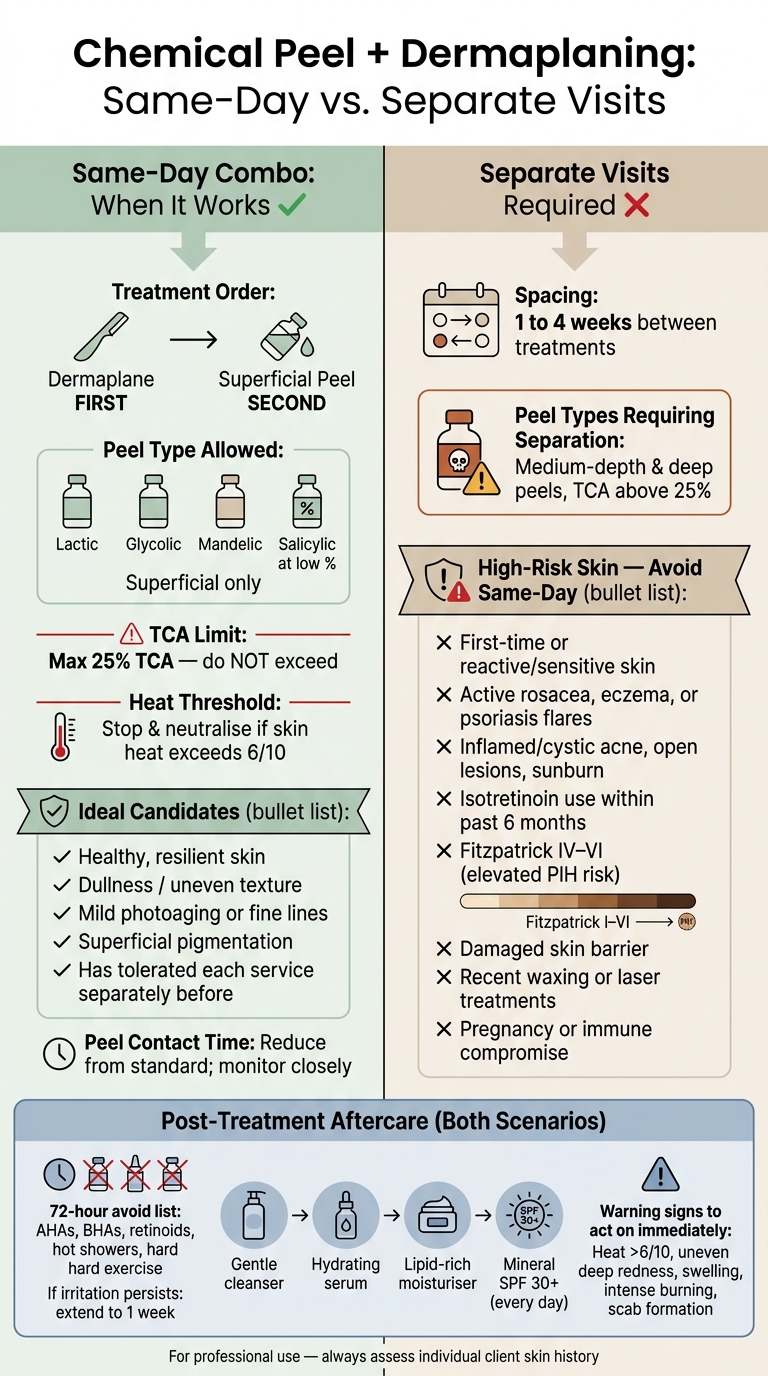
Chemical Peel + Dermaplaning: Same-Day vs. Separate Visits Guide
Dermaplaning with Chemical Peels – Should You Combine Them?
sbb-itb-c911f39
When to combine them and when to space them out
Dermaplaning can make a peel go in deeper, so timing matters. The right approach depends on the depth of the peel and how well the skin handles treatment.
Same-visit order: dermaplane first, then a light peel
If you’re doing both in one visit, dermaplane first and then use only a superficial peel with less contact time. Keep client heat below 6/10. That order sounds simple, but it only works when the client’s skin can handle the combo.
When separate visits are the safer choice
Separate visits make more sense for first-time clients, reactive or sensitive skin, and medium-depth peels. With new clients, it’s smarter to split the services so you can see how their skin responds first.
TCA above 25% should not be applied right after dermaplaning. At that point, penetration is less predictable, and the risk of burns goes up fast. In those cases, space treatments 1 to 4 weeks apart.
Those timing rules also help flag the skin types that need a staged plan instead of a same-day treatment.
Who is a good fit and who is not
Best-fit clients for combined treatment
Once timing lines up, client selection is the next checkpoint. The best candidates usually have healthy skin and concerns such as dullness, uneven texture, mild photoaging, superficial pigmentation, or fine lines. Even then, same-visit treatment should only happen after the client has handled each service well on its own.
For layered peels, providers should use fewer layers and be ready to neutralise sooner than usual.
Contraindications and higher-risk clients
Skip same-day treatment when there is active inflammatory skin, open lesions, sunburn, or any sign of a damaged barrier. Dermaplaning over inflamed acne can make lesions worse. And applying a peel to a compromised barrier can lead to uneven penetration and burns.
Clients with a history of keloids, recent waxing or laser treatments, strong topical actives, pregnancy, or immune compromise need case-by-case review. In most cases, staged visits make more sense than doing both services on the same day.
A simple way to screen is to split low-risk clients from higher-risk skin profiles:
- Active rosacea, eczema, or psoriasis flares - high risk of barrier damage; avoid combination
- Inflamed or cystic acne, open lesions, sunburn - postpone both services
- Isotretinoin use within the past 6 months - do not combine
- Fitzpatrick IV–VI - PIH risk goes up, especially with medium-depth peels; use patch testing and more cautious acids such as mandelic or salicylic acid
Clients in the higher-risk group need a more cautious plan and closer post-treatment instructions.
Expected skin response and aftercare after both treatments
Normal reactions and signs to watch closely
After using a hair identifier spray for dermaplaning and completing the treatment, even a light peel can hit harder and reach its endpoint faster. Skin often feels more sensitive during application, so it needs close attention from start to finish.
Some reactions are normal: transient redness for 6 to 24 hours, mild tightness, tingling, and warmth during application. A bit of visible flaking or peeling in the next few days is also expected, and it can be more noticeable than with a peel on its own.
That said, there are clear signs to act on right away. If the heat sensation during peel application goes above 6 on a 1–10 scale, neutralise at once. Also watch for redness that gets deeper in uneven patches during treatment, swelling that doesn’t settle, intense burning, or any sign of a burn or scab forming.
How to adjust aftercare and home instructions
For the first 72 hours, avoid hot showers, hard exercise, and products with AHAs, BHAs, or retinoids. If irritation sticks around, stretch that window to 1 week.
Keep the routine simple:
- Use a gentle cleanser
- Apply a hydrating serum
- Follow with a lipid-rich moisturiser to help the barrier recover
- Wear a broad-spectrum mineral SPF 30+ every day
That last step matters A LOT. Freshly treated skin is more exposed to UV damage. And in Canadian winters, the mix of indoor heat and cold outdoor air can push transepidermal water loss (TEWL) higher, so a heavier cream or occlusive balm at night can help support the barrier.
Providers should explain all of this before the appointment, not after. If redness or peeling lasts longer than expected, stage the next treatment instead of doing the combo again.
When separate visits make more sense
Cases where staging helps protect the skin barrier
When skin is new to treatment, reactive, or on track for a stronger peel, it’s often smarter to split the services. This gives you time to check the barrier before adding acids. If the first treatment leads to more sensitivity than expected, book the next step for a later visit instead of stacking everything on the same day.
For first-time clients, start with dermaplaning on its own. Then add the peel at a later appointment once you know how their skin responds. Sensitive skin often does better with alternating visits rather than same-day layering. Medium-depth and deep peels should be done in separate appointments.
Main points for Canadian providers
For Canadian providers, seasonality matters too. In Canada, stronger exfoliation is often best scheduled in fall or winter, when UV exposure is lower. That can help reduce the risk of post-treatment pigmentation.
FAQs
How do I know if a client’s skin barrier is strong enough for both treatments?
Start with a thorough professional consultation and take a phased approach. Do dermaplaning and chemical peels in separate sessions, with 2 to 4 weeks between them, so you can see how the skin responds to each treatment.
Don’t combine these treatments if the client has active acne, sunburn, eczema, psoriasis, open wounds, rashes, or a compromised skin barrier. For sensitive or first-time clients, book the peel 1 week after dermaplaning. Always patch test Fitzpatrick skin types IV to VI.
Which superficial peels are safest after dermaplaning?
After dermaplaning, superficial chemical peels are usually the safest pick. They work on the epidermis only, which makes them a good fit for combination treatments.
Common options include glycolic, lactic, mandelic, and salicylic acid, along with low-strength Jessner’s solutions and light TCA. Keep the peel’s concentration and pH within superficial limits to help avoid dermal injury and stay within cosmetic scope.
How long should I wait before repeating this combo?
When you pair dermaplaning with a chemical peel, the usual timing is every 4 to 6 weeks. That gap gives the skin time to renew and settle down, which helps cut the risk of irritation.
Since dermaplaning can make a peel sink in more deeply, it’s smart to check each client’s skin response on a regular basis to make sure this schedule still fits their needs.