

If I combine the two, I put dermaplaning first. If microneedling was done first, I wait 3 to 4 weeks before dermaplaning.
Here’s the short answer:
- Best order: dermaplaning, then microneedling
- Why: dermaplaning removes surface dead skin and vellus hair first, which can help create a cleaner treatment surface
- Main risk of doing it after: skin is red, tender, and barrier-weakened right after microneedling
- Wait time after microneedling: about 3–4 weeks, or until redness and sensitivity are gone
- Who may need more time: people with sensitive skin or a higher risk of post-inflammatory hyperpigmentation
One detail stands out: dermaplaning removes about 21 days of surface buildup in one session. Microneedling, on the other hand, makes controlled micro-injuries to support collagen and elastin.
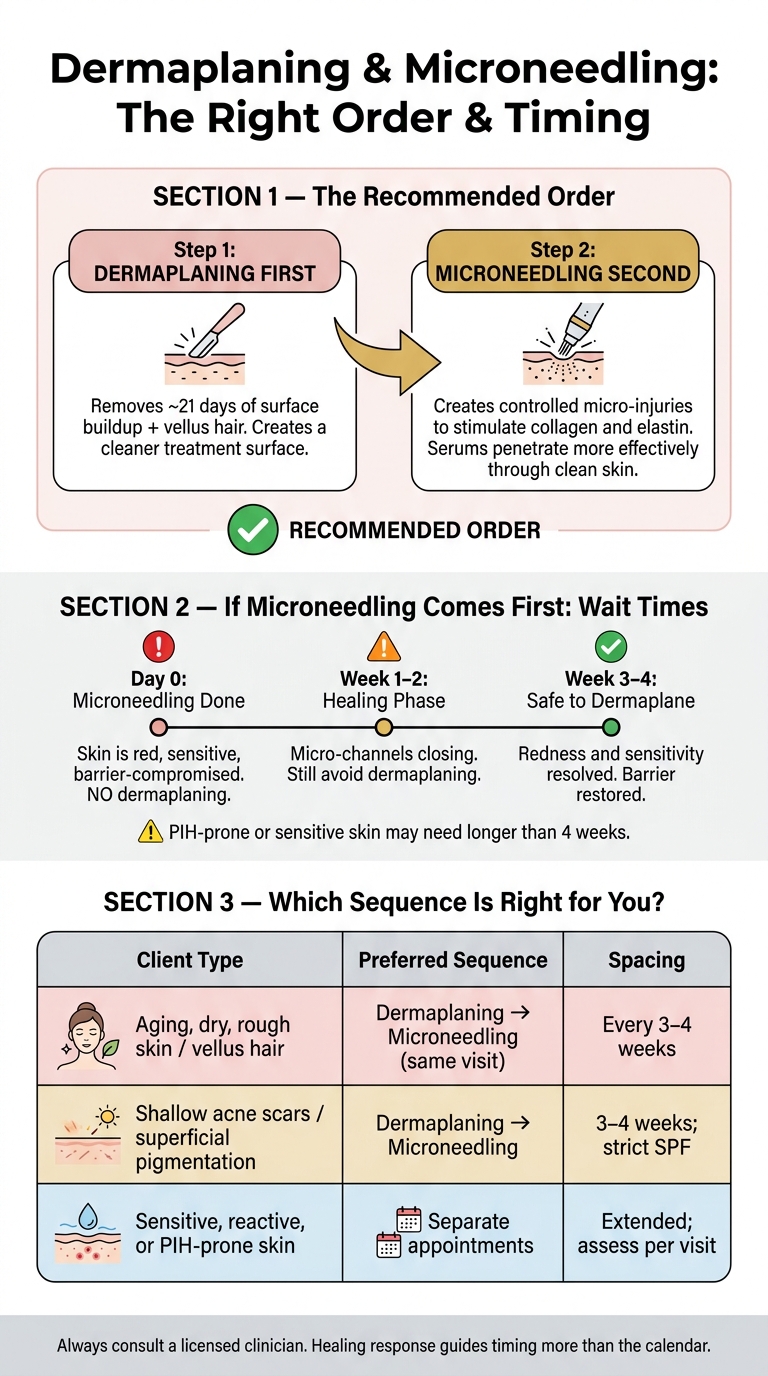
Dermaplaning & Microneedling: The Right Order & Timing
Quick Comparison
| Option | Order | Irritation risk | Timing |
|---|---|---|---|
| Same visit | Dermaplaning before microneedling | Higher than microneedling alone | Same day, if skin can handle it |
| Microneedling first | Dermaplaning later | High if done too soon | Wait 3–4 weeks |
| Sensitive or PIH-prone skin | Separate visits | Lower with more spacing | Based on healing |
So if you want the simple version, it’s this: I’d dermaplane first, avoid doing it right after microneedling, and leave more time if the skin is reactive.
sbb-itb-c911f39
Dermaplaning before microneedling: the standard order
In clinic, dermaplaning usually comes before microneedling. The reason is pretty simple: it removes dead skin and vellus hair from the surface first. That leaves a cleaner canvas and can help serums move through the micro-channels more easily during microneedling.
Skin response, hair removal, and treatment visibility
When vellus hair and surface buildup are removed before needling, the clinician gets a smoother area to work on. That can make the skin’s response easier to see during treatment and help with a clearer view of needle placement.
Dermaplaning is a good fit for aging, dry, rough, uneven-toned skin, vellus hair, shallow acne scars, fine lines, and superficial hyperpigmentation. It should be avoided over dark, coarse terminal hair.
Downtime and client fit
Doing both treatments on the same day can lead to more redness and sensitivity. For sensitive or reactive skin, it’s often better to space visits 3 to 4 weeks apart.
That same-day plan works well for some clients. Others do better with more time between sessions.
Comparison table: Microneedling alone vs. dermaplaning before microneedling
| Feature | Microneedling Alone | Dermaplaning Before Microneedling |
|---|---|---|
| Product penetration | Increased via micro-channels | Maximized; barrier removal allows deeper serum reach |
| Treatment visibility | Standard visibility of the skin response | Clearer view of the skin's response and needle placement |
| Irritation | Moderate - redness and sensitivity | Higher; the skin receives both exfoliation and needling |
| Downtime | Redness and slight sensitivity; return to activities immediately | Minimal to moderate; depends on skin barrier strength |
If microneedling comes first, dermaplaning needs more spacing, which the next section covers.
Dermaplaning after microneedling: when to wait and why
If microneedling comes first, the timing changes. You usually need a bigger gap before dermaplaning. That’s because skin right after needling is in no shape for extra exfoliation, so post-microneedling dermaplaning is usually delayed and not the preferred move.
Immediate aftercare vs. delayed dermaplaning
Freshly needled skin is red, sensitive, and barrier-compromised. Microneedling creates controlled micro-injuries that leave the barrier temporarily open. If you dermaplane that skin too soon, you increase the risk of irritation and infection. So, immediate post-needling dermaplaning is generally contraindicated.
The wait time depends on needle depth and how the skin looks as it heals. In most cases, that means waiting until redness and sensitivity fully settle, usually about 3 to 4 weeks after microneedling. The key point? Visible recovery matters more than picking a date on the calendar. Delayed dermaplaning only makes sense once the skin has fully calmed down.
When dermaplaning later in a microneedling series may work
Once healing is complete, dermaplaning may help smooth leftover flaking before the next session. This tends to suit clients with no active inflammation.
For clients with a higher PIH risk, including deeper Fitzpatrick skin types, it’s smarter to leave more time between treatments. Sometimes the safer option is simply to wait longer.
Comparison table: Immediate vs. delayed post-microneedling dermaplaning
| Feature | Immediate Post-Microneedling | Delayed (3–4 Weeks) |
|---|---|---|
| Barrier status | Compromised; micro-channels open | Restored and normalized |
| Irritation risk | Very high; skin is already red and sensitive | Low; initial inflammatory phase complete |
| Pigmentation risk | High risk of PIH | Low; once inflammation has resolved |
| Infection risk | Elevated due to open micro-injuries | Minimal; surface barrier is intact |
| Typical timing in practice | Not recommended | 3–4 weeks, or once redness and sensitivity resolve |
Client skin type, inflammation risk, and treatment goals determine whether that delay should be longer.
Choosing the right sequence for different clients
The right sequence comes down to three things: barrier health, hair type, and healing response. Two clients can book the exact same protocol and still react in very different ways. That’s why recovery speed and barrier strength should guide whether you combine treatments in one visit or split them up.
Cases that favour dermaplaning first
If the skin can handle both treatments, dermaplaning first is usually the cleaner option. It tends to work best for clients with aging, dry, rough skin or visible vellus hair. It also fits protocols aimed at shallow acne scarring and superficial pigmentation.
Cases that need more spacing or a separate visit
If the barrier is reactive, spacing matters more than convenience. Sensitive, reactive, or PIH-prone skin should be booked for separate appointments. And if a client has dark, coarse facial hair, those areas should be left out of dermaplaning.
The table below keeps the choice simple for the client types most clinics see.
Comparison table: Client type and recommended sequence
| Client Profile | Treatment Goal | Preferred Sequence | Spacing |
|---|---|---|---|
| Aging, dry, rough skin or vellus-hair concern | Improve product penetration | Dermaplaning immediately before microneedling | Every 3–4 weeks |
| Shallow acne scarring / superficial pigmentation | Resurfacing and collagen support | Dermaplaning before microneedling | 3–4 weeks between sessions; monitor redness; strict SPF |
| Sensitive, thin, or PIH-prone skin | Collagen support with reduced irritation risk | Separate appointments; pause acids | Extended spacing; assess per visit |
| Dark, coarse facial hair | Avoid irritation in treated areas | Exclude those areas from dermaplaning; microneedling per protocol | Per microneedling protocol |
Conclusion: How to combine dermaplaning and microneedling safely
Put it all together, and the clinic default is pretty simple: dermaplane first.
Start with dermaplaning to remove surface debris and vellus hair before microneedling. That gives you a cleaner surface to work on. Dermaplaning right after needling should be avoided because the skin is red, sensitive, and its barrier is temporarily compromised after treatment.
Combined sessions should usually be spaced 3–4 weeks apart so the barrier has time to recover. In day-to-day practice, that timing only shifts when barrier health or skin sensitivity calls for more time between visits.
Safe technique also depends on the basics being done well:
- Sterile, single-use blades
- Proper sharps disposal
- Disposable gloves
Proper tools and training lower the risk of skin damage and infection.
Clinics should use professional blades, starter kits, and training to support safe technique. If the skin is reactive, split the treatments instead of stacking them, and make healing the top priority.
FAQs
Can all skin types combine these treatments?
Both dermaplaning and microneedling are generally safe for most skin types, including sensitive skin. But pairing them isn’t something to do on autopilot. It calls for a careful, professional assessment first.
Since both treatments exfoliate or stimulate the skin, a practitioner should look at each client’s skin health, history, and current concerns before moving ahead. If someone has active skin issues or higher sensitivity, it may make more sense to space the treatments apart. That gives the skin time to recover and helps lower the risk of over-exfoliation.
How do I know if my skin has healed enough?
Initial sensitivity often eases within 24 to 48 hours, but the skin barrier may need about 28 days to fully repair itself.
Pay attention to signs like redness, stinging, or burning. During the healing period, skip both physical and chemical exfoliation, including retinoids and acids, for 48 hours to two weeks after treatment. It’s also smart to wait at least 72 hours before using stronger actives like retinol.
For guidance that fits your skin, speak with a skincare professional.
Should I avoid active skincare before or after treatment?
Yes. Skip active skincare before and after treatment to help prevent irritation and damage to the skin barrier.
Before dermaplaning, a professional should look over the client’s routine, since recent use of retinoids or acids can leave the skin more fragile. After treatment, avoid retinoids, AHAs, BHAs, vitamin C, and benzoyl peroxide for at least one week.
Stick with a gentle cleanser, good hydration, and sunscreen during recovery. Once the skin has fully settled, actives can be added back in slowly.