

Dermaplaning offers temporary smoother-feeling skin and vellus-hair removal - not permanent hair removal or scar correction. Before treatment, record the client’s goal, check skin and health history, and explain limits and risks.
A clear consultation covers:
- Suitability and consent: Review medications, recent procedures and skin concerns. Defer treatment or refer when needed, and follow provincial or territorial requirements.
- Results and recovery: Explain likely changes without promising a fixed duration or no downtime. Ask clients to describe expectations in their own words.
- Aftercare and warning signs: Provide written care instructions, including SPF 30 or higher, and explain when medical assessment is needed.
- Follow-up and records: Document treatment details, compare results with the agreed goal and rebook only after recovery and reassessment.
The aim is simple: agree on what treatment can deliver, then check whether the result matched that plan.
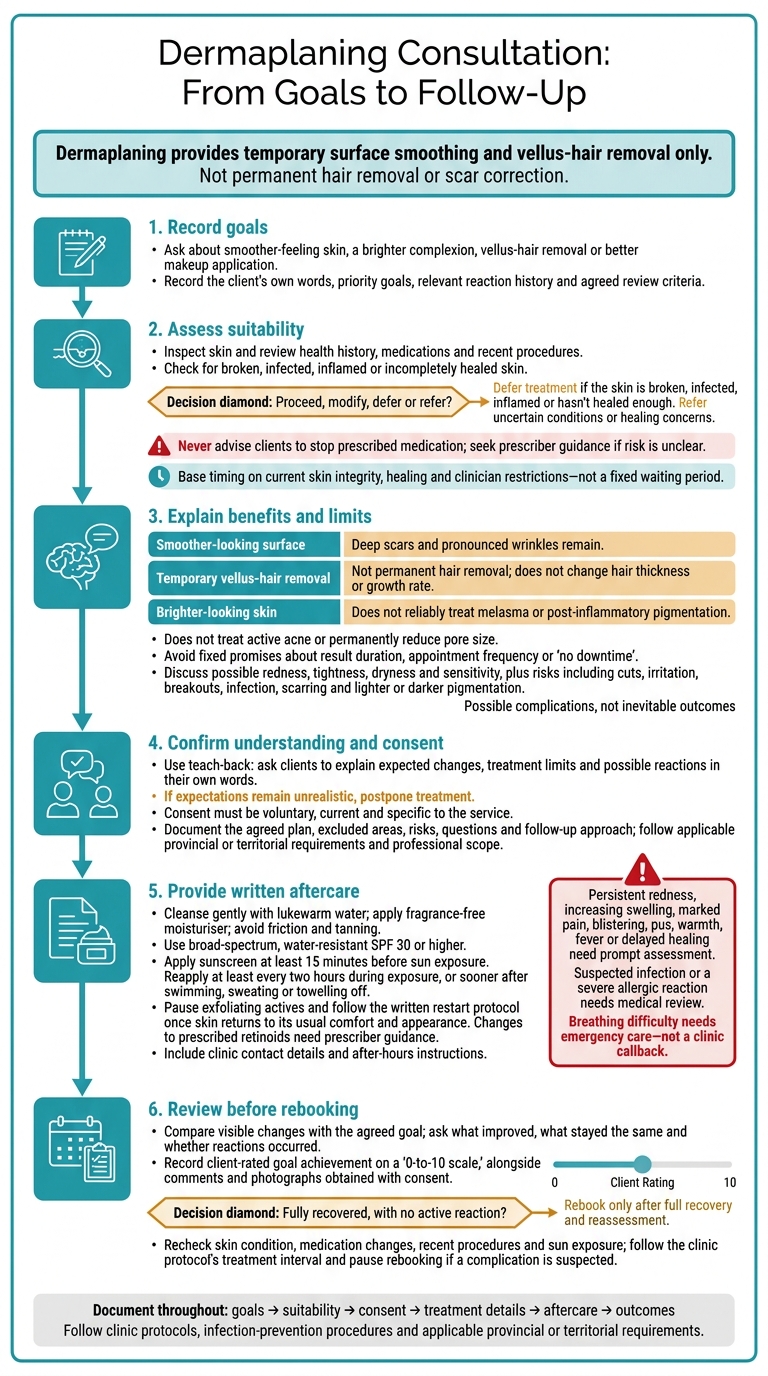
Dermaplaning Consultation: From Goals to Follow-Up
Checklist: Assess Goals and Skin Suitability
Record the Client’s Goals
Ask what matters most to the client: smoother-feeling skin, a brighter complexion, vellus-hair removal or better makeup application. Set clear expectations: dermaplaning provides temporary surface smoothness and vellus-hair removal only. It doesn’t permanently remove hair, treat active acne, erase scars or correct pigmentation or wrinkles.
Record the client’s own words, priority goals, relevant reaction history and agreed review criteria. Matching their goals to the treatment’s limits helps prevent disappointment. Use these notes to assess whether their skin can safely support the requested result.
Review Skin, Medications and Recent Procedures
Inspect the treatment area under bright light. Check for acne, open lesions, infection, cold sores, dermatitis, eczema, psoriasis, rosacea flares, sunburn, windburn, dryness, peeling and barrier damage. Don’t treat over raised scars, moles, skin tags or other atypical growths. Record the location and symptoms of each finding.
Review medication use, including isotretinoin, retinoids, exfoliating acids and blood thinners. Also ask about bleeding disorders, diabetes, cancer treatment, raised scars and delayed healing. Record medication names and when they were last used. Never advise clients to stop prescribed medication; seek guidance from the prescriber if the risk is unclear.
Record the dates and treatment areas for recent peels, waxing, laser, intense pulsed light (IPL), microneedling, dermabrasion, injectables, surgery or other resurfacing procedures. Base timing on the skin’s current integrity, healing and the treating clinician’s restrictions - not a fixed waiting period. Use this review to decide whether to proceed, modify treatment or defer it.
Confirm Suitability and Obtain Informed Consent
Document the decision to proceed, modify, defer or refer, along with the reason. Defer treatment if the skin is broken, infected, inflamed or hasn’t healed enough. Refer clients with uncertain conditions, unusual hair growth or healing concerns.
Before proceeding, record suitability, excluded areas, known risks, aftercare instructions and the client’s questions. Consent must be voluntary, current and specific to the service. It must also meet applicable provincial or territorial requirements and stay within professional scope.
Clear records provide a baseline for the aftercare review and make follow-up comparisons easier. They also help reduce avoidable disappointment. Clients who understand what to expect are more likely to feel satisfied at review and rebook with confidence.
sbb-itb-c911f39
Checklist: Explain Expected Results and Limits
Once suitability is confirmed, explain what clients can expect - and what the treatment cannot do.
Separate Cosmetic Changes from Treatment Limits
Use this table to explain which visible changes clients may notice and which concerns will remain.
Expected cosmetic change Treatment limitation Suggested consultation wording Smoother-looking surface; superficial texture and fine lines may appear softer Deep scars and pronounced wrinkles remain The surface may look smoother, but deep scars remain. Temporary vellus-hair removal Not permanent hair removal Dermaplaning does not change hair thickness or growth rate. Brighter-looking skin Does not reliably treat melasma or post-inflammatory pigmentation Your skin may look brighter, but pigmentation may remain.
Make clear that dermaplaning does not treat active acne or permanently reduce pore size. Before proceeding, use teach-back: ask clients to explain the expected changes, treatment limits and possible reactions in their own words. Correct any misunderstandings. If expectations remain unrealistic, postpone treatment.
Discuss Result Duration, Recovery and Risks
Avoid fixed promises about how long results will last, appointment frequency or “no downtime”. Results depend on skin condition, hair-growth patterns, technique and aftercare. Regrowth may briefly feel blunt, but the hair does not become thicker.
Explain possible redness, tightness, dryness and sensitivity. Burning or tingling can last up to 48 hours in some clients. Discuss cuts, irritation, breakouts, infection, scarring and lighter or darker pigmentation as possible complications - not inevitable outcomes.
Tailor recovery and sun-protection advice to each client. Base future appointments on reassessment rather than a fixed schedule. Keep follow-up discussions consistent with what you explained during the consultation.
Document the Treatment Plan
Record the agreed plan, excluded areas, treatment limits and follow-up approach. Include the client’s teach-back response and any unanswered questions. Document the tool used and how it was disposed of. Record the agreed message so you can compare it with the client’s experience at review.
Checklist: Give Aftercare and Review Outcomes
After treatment, provide written aftercare and use a structured review to check whether the result matched what was agreed during the consultation.
Explain Home Care and Warning Signs
Give each client a personalised aftercare sheet or secure digital copy before they leave. Keep home-care instructions together: cleanse gently with lukewarm water, apply fragrance-free moisturiser, avoid friction and tanning, and use broad-spectrum, water-resistant SPF 30 or higher.
Health Canada recommends applying sunscreen at least 15 minutes before sun exposure. Reapply at least every two hours during exposure, or sooner after swimming, sweating or towelling off.
Pause scrubs, glycolic or salicylic acids, retinol and prescription retinoids. Follow the written restart protocol once skin returns to its usual comfort and appearance. Any changes to prescribed retinoids need prescriber guidance.
Include the clinic’s contact method, response hours, expected response time and after-hours instructions. If clients report a concern, ask for the appointment date, when symptoms started, products used, well-lit photographs and any relevant medication changes. Advise them not to start new actives while waiting for advice unless directed.
Persistent redness, increasing swelling, marked pain, blistering, pus, warmth, fever or delayed healing need prompt assessment. Suspected infection or a severe allergic reaction needs medical review. Breathing difficulty needs emergency care - not a clinic callback.
Review Results Before Rebooking
At follow-up, compare visible changes with the agreed goal and check recovery against the documented treatment plan. Ask what improved, what stayed the same and whether any reactions occurred. This connects the consultation to the outcome, rather than measuring satisfaction alone.
If the client is disappointed, acknowledge their concern. Discuss the gap using the documented treatment limits, without promising a corrective result.
Rebook only after full recovery, with no active reaction. Review the client’s current skin condition, medication changes, recent procedures and sun exposure. Follow your protocol’s treatment interval, and pause rebooking if you suspect a complication.
Keep the review honest: don’t minimise risks or overstate benefits. When the outcome matches the plan, clients can approach rebooking with more confidence.
Standardise Forms and Treatment Supplies
Use consistent templates to document goals, health and medication history, skin assessment, consent, treatment details, product and blade information, aftercare delivery, adverse-event communication and follow-up notes. Use unambiguous dates and metric measurements where relevant.
Date format example: 15 March 2026.
Record client-rated goal achievement on a 0-to-10 scale, alongside comments and photographs obtained with consent. Keep forms and aftercare sheets accurate, specific to the treatment and aligned with clinic protocol. Supplier materials and training do not replace provincial requirements, infection-prevention procedures or your legal scope of practice.
Conclusion: Confirm Goals, Limits and Follow-Up
Before the client leaves, review the agreed plan. Confirm their goal, skin suitability, expected benefits, treatment limits, consent, aftercare and follow-up. Document consent as part of the consultation discussion - not just on the form.
Ask the client to explain the expected result and key precautions in their own words. Clear up any gaps in understanding: dermaplaning provides temporary surface smoothing and vellus-hair removal only.
This final check, along with realistic expectations and prompt follow-up, helps reduce disappointment and build long-term trust. Decide together whether to rebook based on the client’s response, rather than making an automatic promise.
FAQs
How can I assess whether a client’s expectations are realistic?
Review the client’s medical history, allergies, medications and recent treatments. Then examine their skin visually and by touch to check for treatment limits or contraindications. Confirm their goals and set clear expectations: dermaplaning supports smoother texture and product absorption, not dramatic wrinkle reduction or complete hair removal.
Use before-and-after photos of similar skin types to show what clients can expect. Explain temporary redness, the typical 4–6-week interval between treatments, and patch testing to check for sensitivity. Document the consultation and obtain informed consent that covers expected outcomes and risks.
How should I handle conflicting skin suitability information?
Put safety first: follow formal assessment protocols rather than subjective input. Review the client’s health history and contraindications, then check the skin for signs of a compromised barrier. If you’re unsure, patch test a discreet area and monitor it for 24 to 48 hours.
For clients with complex medical histories, require written clearance from a dermatologist or GP. When in doubt, postpone treatment. Record your findings, decisions and informed consent in the client’s permanent record, following local regulations.
How can I track whether consultations improve client retention?
Keep detailed records of each client’s history, treatment responses, and healing times. Schedule follow-up visits every 4 to 6 weeks to check progress, discuss skin goals, and adjust treatment plans based on results.
These notes help you see what works best for each client, keep future appointments running smoothly, and support consistent results. They also show the value of your services and the professional care behind them, helping build long-term client trust and retention.