

The global dermaplaning market is growing fast, valued at $612.2M USD in 2023 and projected to reach $1.01B USD by 2030, with a 7.4% annual growth rate. North America leads with 36.9% of the market, driven by consumer interest in quick, low-recovery skincare treatments. In Canada, demand is fuelled by professional-grade tools, training, and a focus on clinical safety standards. While at-home kits dominate over 70% of the market, certified practitioners using surgical-grade tools set themselves apart by offering safer, more effective results.
Key takeaways:
- Market Growth: Global CAGR between 6.2%–8.0%.
- North America: 7.5% CAGR, $370.1M USD (~$502.6M CAD) by 2030.
- Canada: Strong focus on clean beauty, safety, and premium tools.
- Professional Tools: Surgical-grade blades like Swann Morton's #10R, paired with certification programs, are vital for practitioners.
- Training: Certification courses from $199.99 CAD help professionals meet rising standards.
Canadian professionals can thrive by using high-quality tools, obtaining certifications, and emphasizing clinical safety to meet growing consumer expectations.
Global and Canadian Market Size and Growth
The global market for dermaplaning tools is on a steady climb, with projections estimating a growth rate between 6.2% and 8.0% CAGR. By the early 2030s, it’s expected to hit approximately USD 1,074.65 million. This surge is driven by increasing consumer interest in non-invasive skincare options and the influence of social media, which has amplified awareness and demand.
North America remains the frontrunner in this global market, accounting for 36.9% of worldwide revenue in 2024. This translates to USD 241.4 million, with a growth trajectory of 7.5% CAGR, leading to an anticipated USD 370.1 million by 2030. Factors such as higher disposable incomes and a strong preference for premium skincare products fuel this growth.
Canada plays a critical role in this North American dominance. The broader aesthetic devices market in Canada was valued at USD 1.61 billion in 2026, with projections to reach USD 2.95 billion by 2031. The country benefits from a well-developed medical infrastructure and regulatory initiatives like Health Canada's Medical Device Single Review Program, which ensures safety and accelerates the adoption of advanced technologies. These regulatory measures have helped establish a strong demand for professional-grade dermaplaning tools.
While over 70% of the market is driven by at-home use, the professional sector remains a key driver of innovation in high-quality tools. In 2024 alone, more than 3.7 million skin resurfacing procedures were performed, supported by 10,488 medical spas operating across North America as of November 2024. This extensive infrastructure continues to push the demand for sterile, surgical-grade blades and equipment that meet stringent clinical safety standards.
For Canadian skincare professionals, these trends highlight the necessity of using premium, clinically safe tools to meet rising client expectations. Dermaplaning Supplies Canada (https://dermaplaningsupplies.com) offers a range of resources tailored to professionals, including wholesale stainless steel blades (available in #10, #10R, and #14 sizes starting at wholesale stainless steel blades (available in #10, #10R, and #14 sizes starting at $12.95 CAD)2.95 CAD), starter kits, and online certification training. These solutions help practitioners maintain the safety and efficacy that distinguish professional services from at-home alternatives, ensuring they stay competitive in this growing market.
sbb-itb-c911f39
Regional Growth Rates and Market Drivers
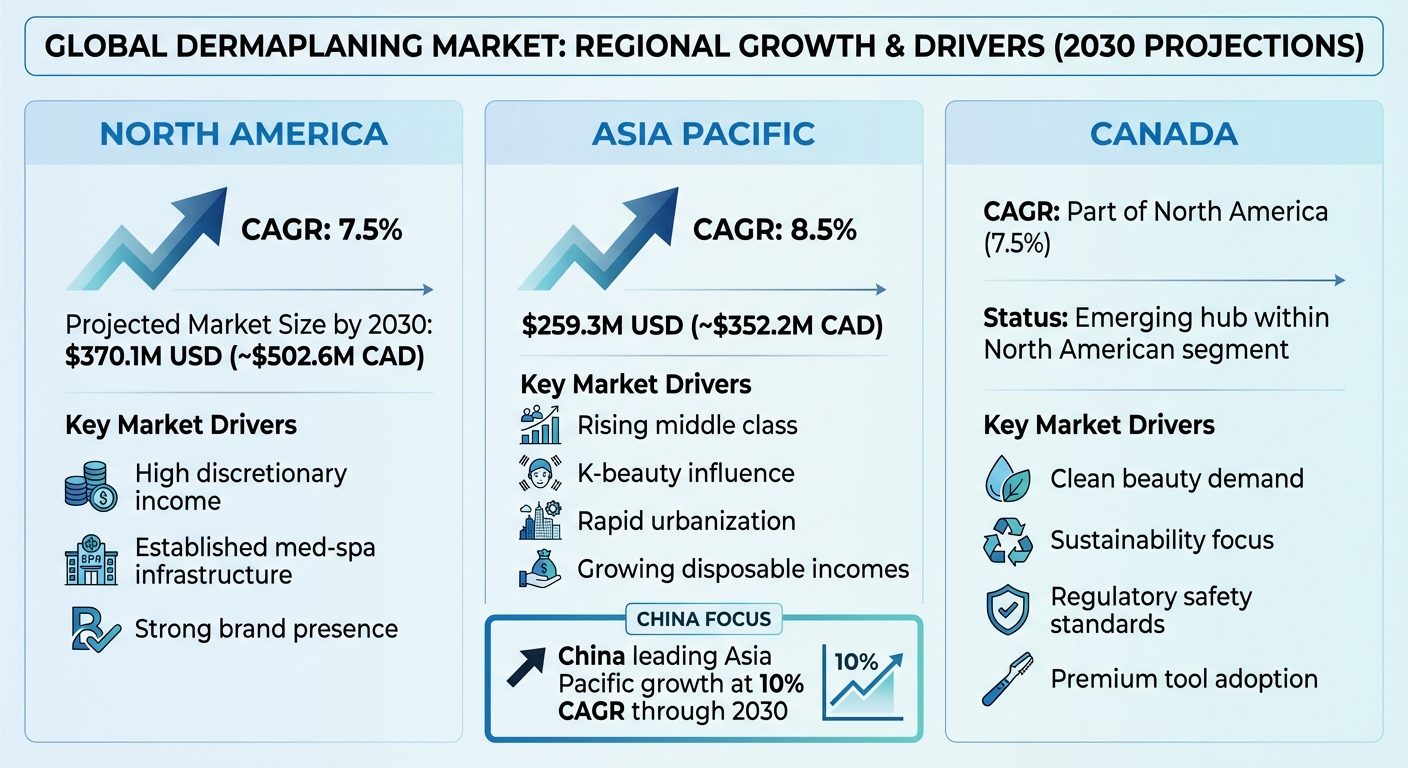
Dermaplaning Market Growth: Regional Comparison 2024-2030
North America is holding steady with a 7.5% CAGR, but Asia Pacific is surging ahead at 8.5%, with China leading the way at an impressive 10% growth rate through 2030. North America’s growth is anchored by its established infrastructure and strong consumer awareness. Meanwhile, Asia Pacific benefits from rapid urbanization and a burgeoning middle class, particularly in China and India.
Within North America, Canada is carving out a niche with its emphasis on clean beauty and eco-conscious practices. Canadian consumers are increasingly drawn to sustainable products, favouring recyclable packaging and environmentally friendly materials. This aligns with the broader North American trend of premium, professional-grade tools, supported by higher discretionary incomes.
Here’s a snapshot of the regional growth trends and their driving factors:
| Region | CAGR | Key Market Drivers | Projected Market Size by 2030 (CAD Equivalent) |
|---|---|---|---|
| North America | 7.5% | High discretionary income, established med-spa infrastructure, strong brand presence | $370.1 million USD (~$502.6 million CAD) |
| Asia Pacific | 8.5% | Rising middle class, K-beauty influence, rapid urbanization, growing disposable incomes | $259.3 million USD (~$352.2 million CAD) |
| Canada | Part of North America | Clean beauty demand, sustainability focus, regulatory safety standards, premium tool adoption | Emerging hub within the North American segment |
Canadian professionals are increasingly tailoring their offerings to meet local preferences for clinical safety and eco-conscious solutions. For example, Dermaplaning Supplies Canada (https://dermaplaningsupplies.com) offers sterile, surgical-grade blades starting at $12.95 CAD, along with expert training and dermaplaning treatment protocols to help practitioners keep pace with these evolving consumer demands.
Professional Equipment and Training in Canada
In Canada, professionals are stepping up their game by investing in surgical-grade tools and robust certification programs to meet the growing demand for clinical-quality treatments. A great example is the #10R "Butter Blade" from Swann Morton, which has earned a perfect 5.0/5.0 rating from 30 reviews. This blade, designed with a rounded "bull nose" tip for added safety in delicate areas like the nose, mouth, and brows, costs between $109.95 and $129.95 CAD per box of 100. In comparison, the standard #10 blade is priced at $29.95 to $49.99 CAD.
Made from stainless and carbon steel with a polymer coating for long-lasting sharpness, these blades are exclusively available to certified practitioners, as vendors require proof of certification before purchase. This aligns with global standards, as Swann Morton blades are highly regarded for their precision and reliability.
Online certification programs are also making professional training more accessible. For example, Dermaplaning Supplies Canada offers courses for $199.99 CAD (discounted from $399.99 CAD). These courses include an 18-page manual covering essential topics like contraindications, blade differences, and six detailed treatment protocols that range from basic to clinical (lasting 30–60 minutes). The curriculum also delves into licensing, insurance requirements, and marketing strategies, equipping professionals to seamlessly incorporate dermaplaning into their practices. Dermaplaning starter kits complement this training, giving newcomers the tools they need to meet clinical standards.
Starter kits are available at various price points, starting at $59.99 CAD for basic #10 bundles and going up to $159.95 CAD for #10R essentials. For those looking for a complete setup, educator bundles range from $699.95 to $899.50 CAD and include tools, training, and digital treatment protocols, providing a business-ready solution.
This focus on precision and safety helps Canada maintain a competitive edge in professional dermaplaning. While social media trends have driven up sales of consumer-grade razors worldwide, Canadian professionals stand out by offering superior surgical-grade equipment and certified expertise. This professional standard ensures consistent service quality and positions practitioners to meet the growing demand for non-invasive treatments with immediate, visible results.
Pros and Cons
Dermaplaning has clear advantages and challenges, both globally and in Canada, shaping decisions around tools, training, and service strategies. This comparison highlights the global drive for innovation alongside Canada's emphasis on high standards and safety.
Globally, the industry is seeing rapid advancements, with electric and sonic devices, eco-friendly materials like recycled resins and wheat straw, and a growing focus on men’s grooming (expected to grow at a 7.9% compound annual growth rate through 2030). However, obstacles remain: 16% of consumers avoid cosmetic treatments due to safety concerns, and counterfeit products sold through online platforms threaten professional integrity.
In Canada, suppliers such as Dermaplaning Supplies Canada prioritize surgical-grade precision by offering sterile scalpels and comprehensive certification programs. These programs align with Health Canada and FDA regulations, ensuring both safety and efficacy . However, strict regulatory requirements can slow down product launches and create barriers for new entrants.
Here’s a breakdown of how global trends and Canadian practices compare:
| Aspect | Global Market Trends | Canadian Professional Offerings |
|---|---|---|
| Innovation | Rapid advancements in electric/sonic devices and sustainable materials | Medical-grade tools paired with clinical treatments |
| Market Reach | Broad accessibility through e-commerce; 71% of consumers influenced by social media | Targeted at high-end skincare clients with professional certification |
| Safety Standards | Inconsistent regulations and counterfeit product risks | Health Canada/FDA oversight ensures strict safety protocols |
| Consumer Focus | Affordable DIY options; disposable razors made up 45.2% of 2023 sales | Premium surgical-grade tools combined with certified expertise |
| Key Challenge | Untrained users risk cuts, nicks, and infections | At-home kits compete with professional services, requiring client education on safety |
Canada’s approach focuses on premium services that deliver results beyond what at-home kits can achieve. While global trends have made dermaplaning more accessible, professional services in Canada offer enhanced benefits like improved product absorption, reduced fine lines, and the treatment of minor scarring. By relying on certified professionals and top-tier surgical tools, Canadian practitioners appeal to clients seeking clinical-grade results rather than basic exfoliation. These comparisons underscore the importance of maintaining high standards in training and equipment, as discussed earlier.
Conclusion
Canada's dermaplaning market is on a growth trajectory, with the aesthetic devices sector projected to hit $2.95 billion by 2031. For skincare professionals, this presents a clear chance to thrive - provided they focus on using professional-grade tools and obtaining certified training, especially as DIY alternatives continue to gain traction.
Although at-home dermaplaning kits are growing in popularity, the professional segment remains strong. Many consumers still prioritize safety and results, particularly since around 16% of individuals avoid cosmetic treatments due to safety concerns. This highlights the importance of adhering to strict local standards and offering reliable, professional services.
In Canada, skincare professionals benefit from a well-established infrastructure and stringent regulations that bolster consumer trust. By partnering with Dermaplaning Supplies Canada, professionals gain access to sterile, surgical-grade blades and certified training that align with these high standards.
Focusing on precision, safety, and visible results - such as improved product absorption and a radiant glow - allows practitioners to stand out from at-home kits. Positioning dermaplaning as a quick, "lunch hour" treatment with no downtime appeals to busy clients who want immediate benefits.
The key to success in Canada’s expanding dermaplaning market lies in maintaining exceptional standards. Professionals who combine certified expertise with top-quality tools are well-equipped to meet the demand for safe, effective treatments that at-home solutions simply cannot match.
FAQs
How can Canadian pros compete with at-home dermaplaning kits?
Canadian professionals can set themselves apart by focusing on the safety, skill, and customized outcomes that professional dermaplaning provides. While at-home kits may seem convenient, professionals bring precision, personalized skin evaluations, and advanced tools that significantly lower risks like irritation or injury. By showcasing additional benefits - such as tailored skincare plans, expert post-treatment guidance, and access to high-quality, professional-grade products - professionals can clearly demonstrate why their services deliver superior results compared to DIY alternatives.
What’s the safest blade type for professional dermaplaning?
When it comes to professional dermaplaning, the safest choice is a sterile, single-use surgical scalpel blade, like the #10R, often called the "butter blade." This blade is crafted specifically to gently and effectively remove fine facial hair and exfoliate dead skin cells. To ensure safety and hygiene, always follow proper sterilization protocols and dispose of blades correctly after each use.
What should a dermaplaning certification course include in Canada?
A dermaplaning certification course in Canada combines theoretical learning with hands-on practice, ensuring practitioners are well-prepared to perform the procedure safely and effectively. Core topics typically include skin histology, indications and contraindications, safety protocols, blade handling techniques, and treatment planning.
Courses also delve into pre- and post-treatment care, health and safety standards, and legal aspects such as licensing requirements and insurance. At the end of the training, participants receive a certificate of completion, signifying their readiness to offer this service professionally.