

Wondering how to master dermaplaning safely and effectively? The choice between formal training and workplace learning depends on your career goals, budget, and provincial regulations. Here’s the gist:
- Formal Training: Offers structured lessons on skin science, safety protocols, and hands-on practice. Includes certification and training kits, boosting credibility and client trust. Costs range from ~$199 to $400 CAD, but it can enhance earning potential.
- On-the-Job Learning: Practical, cost-effective, and flexible. Learn while earning, but quality varies based on mentorship. Lacks formal certification, which may limit future opportunities.
Key Takeaway: Formal training is ideal for those seeking recognized credentials and higher rates, while on-the-job learning suits those in supportive workplaces aiming to expand skills gradually. Always check provincial regulations and insurance requirements before choosing.
COMPLETE DERMAPLANE CLASS & DEMO: LEARN FROM A PRO
sbb-itb-c911f39
Formal Dermaplaning Training Programs
Formal dermaplaning training programs provide a solid foundation that goes well beyond just learning how to handle a blade. These courses blend theoretical knowledge with supervised, hands-on practice, ensuring participants master both the technical and practical aspects. Unlike inconsistent on-the-job training, structured programs focus on safety and skill-building.
Structured Curriculum
A proper training program dives into topics like skin anatomy, client care, and safety protocols. Participants learn about the structure of the epidermis, the distinction between vellus and terminal hair, and the hair growth cycle. Safety is a key focus, covering sterile tool handling, infection control, and identifying contraindications such as active acne, eczema, or rosacea.
Most courses include practical sessions where students work on live models under the guidance of experienced instructors. For instance, the Texas Laser Institute offers a hybrid certification course priced at CAD $395, combining online lessons with in-person training. Participants also explore advanced techniques, like combining dermaplaning with treatments such as chemical peels, LED therapy, or hydrating facials, to enhance results.
This foundational training naturally leads to earning professional credentials.
Professional Certification
Professional certification gives aestheticians a competitive edge in the market by providing recognized credentials. C. Davis, a DermaplanePro Certified Aesthetician, highlights the benefits:
"Being DermaplanePro Certified has significantly boosted my professional confidence. When I educate clients about my certification and the difference between professional dermaplaning versus at-home methods, I see an immediate increase in their trust and satisfaction."
Certification not only builds client trust but also reinforces the importance of standardized, safe practices. It signals a commitment to expertise and safety that both clients and employers value. For example, PhiAcademy offers tiered career paths, ranging from Student to Grand Master, and even includes a "Map of Artists" to help certified professionals boost their visibility. When selecting a program, it’s important to ensure that instructors hold recognized credentials, such as board certifications or titles like FAAD (Fellow of the American Academy of Dermatology).
In addition to certification, many programs offer resources and networking opportunities to support long-term professional growth.
Resources and Networking Opportunities
Beyond technical skills, many dermaplaning programs provide tools and support to help graduates succeed. Starter kits often include essentials like medical-grade blades (e.g., the #10R "Butter Blades"), scalpel handles, and skin prep solutions. A typical kit can supply materials for over 25 treatments, which, at an average service price of CAD $125, represents a potential revenue of approximately CAD $3,125.
Graduates also gain access to clinical protocols, training videos, and online communities for troubleshooting and networking. Some programs even offer marketing support, such as directory listings in "Find a Provider" platforms and downloadable resources like client consent forms and aftercare cards. For Canadian professionals, Dermaplaning Supplies Canada provides online certification along with access to professional-grade tools, making it easier to start or expand dermaplaning services.
On-the-Job Learning Approach
While formal training provides a structured way to learn, gaining experience directly on the job offers a different path. This method allows practitioners to develop their skills in a practical setting, all while continuing to serve clients and earn an income. That said, the success of this approach depends heavily on the expertise of the mentor and the workplace's dedication to maintaining safety standards.
Hands-On Experience
Practical experience delivers lessons that no textbook can fully replicate. By working directly with clients, practitioners learn how to manage different skin types, set realistic expectations, and fine-tune their techniques through repetition. For example, mastering the precise 45° angle and light, short strokes required for safe dermaplaning comes with practice. As Joyce Park, MD, a Board Certified Dermatologist, explains:
"Doing it at home can save money, and it's convenient. You can do it whenever you need or want, and it only takes a couple of minutes."
This real-world setting also helps practitioners quickly recognize contraindications, such as active acne or signs of conditions like PCOS, which may require a referral to a doctor instead of proceeding with treatment. Additionally, learning alongside experienced colleagues fosters a supportive environment, making it easier to refine skills while ensuring client safety. This hands-on approach also provides an affordable way to gain experience without incurring the costs of formal education.
Flexibility and Cost Savings
On-the-job learning offers the advantage of flexibility. Practitioners can start offering dermaplaning services without paying for tuition or certification upfront. With professional sessions typically priced between $75 and $200, this approach allows practitioners to start earning revenue right away. Those already familiar with facial treatments can integrate dermaplaning into their services at their own pace, avoiding the constraints of a formal course schedule.
Inconsistent Training Quality
However, this method comes with its challenges. Unlike formal courses, on-the-job training often lacks standardized dermaplaning protocols, which can increase the risk of developing improper techniques. Medical Aesthetician Cassandra Bankson highlights a key concern:
"There is a risk of cutting or nicking the face. If you scratch the face, it could cause a cut or scar."
The quality of training largely depends on the mentor's expertise. Poor guidance can lead to unsafe practices, such as using incorrect blade angles or failing to sterilize tools properly. Dr. Joyce Park also warns:
"The razor can spread bacteria and worsen irritation."
Additionally, without structured oversight, there’s a higher chance of over-treating clients. For instance, dermaplaning should generally be limited to once or twice per month to avoid damaging the skin barrier.
While on-the-job learning offers a practical and cost-effective way to build skills, it requires a careful balance of mentorship and adherence to safety protocols to ensure successful outcomes.
Comparing Formal Training and On-the-Job Learning
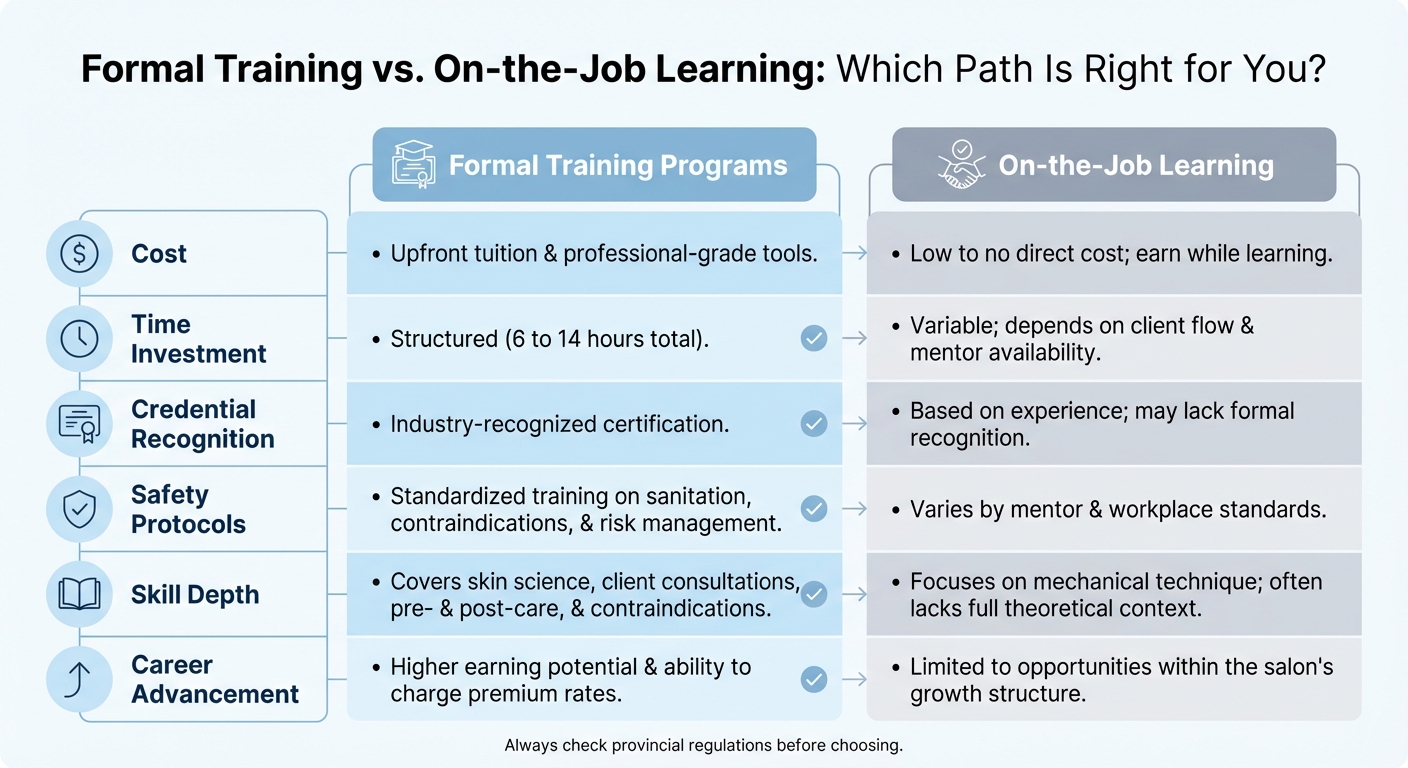
Formal Dermaplaning Training vs On-the-Job Learning Comparison
Deciding between formal training and on-the-job learning often comes down to your career aspirations, budget, and the certification requirements in your province. Both routes have distinct differences in terms of cost, time commitment, and their impact on your long-term career.
Formal training usually involves a significant upfront cost for tuition and professional tools. However, it provides a recognized certification that’s widely accepted across the industry. On the other hand, on-the-job learning has little to no direct expense, letting you earn income as you build hands-on skills. The downside? This path may not lead to a formal credential, which could limit your ability to showcase your expertise when switching jobs or expanding your client base.
The time commitment is another key difference. Formal training programs are structured and often intensive, offering comprehensive coursework that can include up to 14 hours of theory and practice combined. In contrast, on-the-job learning is more flexible but unpredictable, as the pace of skill development depends on client demand and the expertise of your mentor. To give you a clearer picture, here’s a comparison of the two approaches:
Comparison Table: Key Differences
| Feature | Formal Training Programs | On-the-Job Learning |
|---|---|---|
| Cost | Upfront tuition and professional-grade tools | Low to no direct cost; earn while learning |
| Time Investment | Structured (e.g., 6 to 14 hours total) | Variable; depends on client flow and mentor availability |
| Credential Recognition | Industry-recognized certification | Based on experience; may lack formal recognition |
| Safety Protocols | Standardized training on sanitation, contraindications, and risk management | Varies by mentor and workplace standards |
| Skill Depth | Covers skin science, client consultations, pre- and post-care, and contraindications | Focuses on mechanical technique; often lacks full theoretical context |
| Career Advancement | Higher earning potential and ability to charge premium rates | Limited to opportunities within the salon’s growth structure |
Ultimately, your choice should align with provincial regulations and your career goals. If you’re looking to establish a reputable practice and charge premium rates - potentially reaching a six-figure income through advanced skills and specializations - formal training is the stronger option. However, if you’re already in a supportive workplace with experienced mentors and want to add dermaplaning to your existing skill set gradually, on-the-job learning could be a practical way to start. Keep in mind that in some provinces, formal certification may be legally required to offer dermaplaning services.
Conclusion
The training path you choose reflects your dedication to safety and regulatory compliance. Formal certification offers a solid base for understanding contraindications, adhering to safety protocols, and achieving consistent results. As Dermaplaning Supplies Canada highlights:
"Proper training can help to ensure that the treatment is performed safely and effectively, minimizing the risk of injuries and complications".
If your goal is to build credibility and command higher rates, formal training is the logical choice. It provides not only precise techniques for reliable results but also professional certification that helps you stand out in a competitive field. Alternatively, if you're already part of a supportive team with experienced mentors and want to gradually incorporate dermaplaning into your services, on-the-job training might be a practical option. Keep in mind, this decision impacts both your technical skills and your legal ability to practise.
Before committing, make sure to check your province's regulations and confirm with your insurance provider to ensure you're meeting all legal requirements.
Lastly, don't underestimate the importance of professional-grade tools. Dermaplaning Supplies Canada offers online certification for $199.99 CAD (discounted from $399.99 CAD) and comprehensive student bundles priced at $493.72 CAD. These bundles include essentials like #10R Swann Morton blades, scalpel handles, and step-by-step protocols, ensuring your equipment meets safety standards.
FAQs
Do I legally need dermaplaning certification in my province?
In Canada, dermaplaning certification requirements differ by province, as there is no federal mandate. Some provinces might require specific licences or certifications, especially for procedures involving sharp tools like dermaplaning.
It's crucial to consult your local regulatory authority or esthetics college to understand the legal requirements in your area. Even if certification isn't mandatory, completing formal training is strongly advised. This ensures treatments are performed safely and effectively while upholding professional standards.
Will my insurance cover me if I learn dermaplaning on the job?
Insurance coverage varies based on your policy and local regulations. Many insurance providers expect proof of formal training or certification, as it shows you’ve learned proper techniques and safety measures. If you lack formal training, you might encounter fewer coverage options or higher premiums. It’s a good idea to contact your provider directly to see if they accept on-the-job experience to meet their coverage criteria.
How do I know I’m ready to charge for dermaplaning?
Once you’ve completed the necessary training, honed your skills, and feel confident in your ability to perform dermaplaning safely and effectively, you’re ready to start charging for your services. Formal training or certification not only equips you with the right techniques but also boosts your credibility as a professional. When you’re sure of your expertise and can consistently deliver safe, top-notch treatments, you’ll be in a strong position to determine and set your pricing confidently.