

An online dermaplaning certificate only counts if it teaches safety, tests your knowledge, and leaves you with records you can keep. If the course only walks you through videos and gives a certificate at the end, that shows attendance - not safe practice.
Here’s the short answer:
- I’d look for training on skin anatomy, hair growth, skin conditions, contraindications, infection control, blade use, consent, and aftercare.
- I’d check for a graded test or reviewed practical task, not just module completion.
- I’d expect proof of training to include your full name, course title, provider details, and completion date in DD/MM/YYYY format.
- I’d treat online-only learning as theory-first training, not full hand-skill training.
- I’d put more weight on hybrid or supervised practical learning if you’re new, returning to services, or working in a clinic that needs sign-off.
One point stands out: many course platforms only keep access open for 90 days to 6 months. So if you enrol, save your certificate, dermaplaning training manual, and test results right away.
Online learning can cover the classroom side of dermaplaning well. But safe blade angle, pressure, and work on live skin still need watched practice for many providers.
That’s what I’d use to judge whether a course is worth your time.
What a legitimate online dermaplaning safety course should cover
A legitimate course teaches safe assessment and technique before treatment. That begins with skin structure and function, including the difference between vellus and terminal hair. Without that base, it’s much harder to judge whether a client is suitable for treatment or to use safe technique.
Core theory topics that support safe treatment decisions
Safety starts with client assessment. A solid course should show you how to assess skin type with the Fitzpatrick scale, spot skin conditions, disorders, and diseases that may rule out treatment, and review a client’s health history and medication use.
It should then go deep on contraindications - and explain why each one matters. That part is important. When you understand why a condition rules out treatment, you’re in a better position to make sound calls during a consultation. Informed consent belongs here too. A proper course should include consent form templates and teach you how to use them correctly in the consultation record.
The course should also cover treatment planning, blade type selection, safe blade handling, sharps container use for safe disposal, and aftercare. Good aftercare should help limit irritation and support barrier recovery.
That base only means something if hygiene is taught as part of every treatment decision.
How infection control should be taught, not treated as an add-on
Infection control needs to run through the entire course. It affects every part of treatment - from workspace setup to the way a used blade is thrown out.
A strong course will teach hand hygiene, PPE selection, sharps handling, and cross-contamination prevention as separate, practical topics. It should also explain how to clean and disinfect surfaces and tools between clients, and how to deal with clinical waste disposal. These aren’t side notes. They’re clear signs that a course is legitimate.
When a course treats infection control like a box to tick, gaps show up fast in day-to-day practice.
Next, proof of training needs to show that this knowledge was assessed, not just watched.
sbb-itb-c911f39
What online training does well and where its limits are
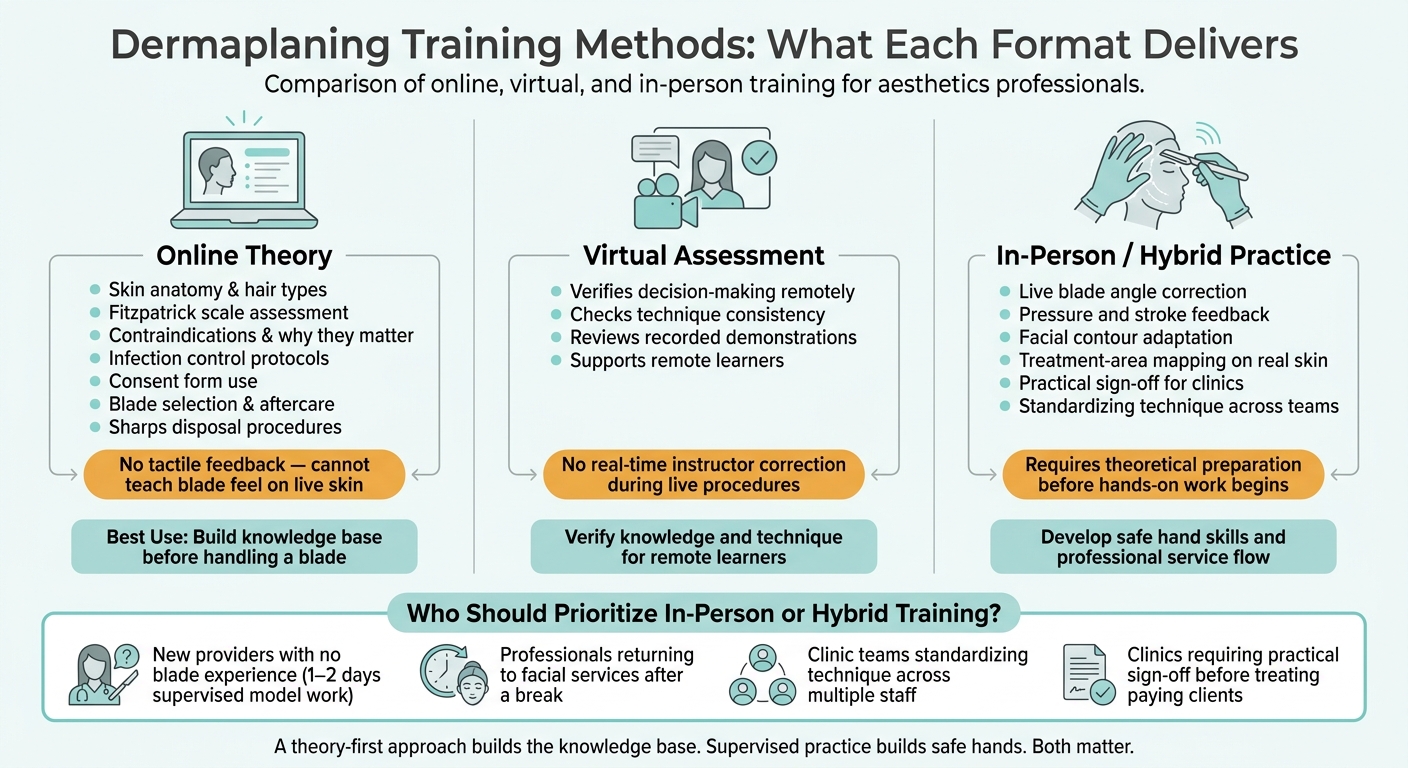
Online vs In-Person Dermaplaning Training: What Each Method Covers
Online learning is strongest for theory and weakest for hands-on control. It gives you a solid knowledge base before you ever pick up a blade. That makes it a strong starting point, but not a complete safety answer on its own.
Its main gap is tactile skill. Blade angle, pressure, stroke consistency, and treatment-area mapping are learned through touch as much as sight. Watching a light, controlled stroke is not the same as doing one on live skin while an instructor stands nearby and corrects your hand position in real time.
Online theory, virtual assessment, and in-person practice side by side
Each training format does a different job, so it helps to look at them next to each other.
| Training Method | Limits | Best Use |
|---|---|---|
| Online Theory | No tactile feedback; cannot teach how the blade moves on skin | Building a knowledge base before handling a blade |
| Virtual Assessment | No real-time instructor intervention during a live procedure | Verifying technique consistency and decision-making for remote learners |
| In-Person Practice | Requires theoretical preparation before hands-on work begins | Developing confidence, safety refinement, and professional service flow |
Why combining online and in-person learning often gives the best safety outcome
A theory-first approach works well because it puts the knowledge in place before the practical work starts. By the time you're working on a live model, you already know why contraindications matter and how to set up a hygienic workspace. That base makes in-person training time more productive.
Supervised model work fills the gaps that video can't. An instructor can spot a poor blade angle, correct your pressure on the spot, and guide you through treatment-area mapping on skin that reacts differently from a demo model. For professionals adding dermaplaning to an existing menu, hybrid training often gives the fastest path from theory to supervised practice.
That only helps if the course also provides records showing the training was completed and assessed.
What proof of training should include
A certificate only helps if it shows what the person learned and how they were tested.
At a minimum, a useful certificate should include the learner’s full name, the exact course title, the training provider’s name and contact details, and the completion date in Canadian format (DD/MM/YYYY). These details can help with insurance or licensing checks. They should appear alongside the rest of the course record, not on their own.
Course records that support salon, spa, and clinic standards
Clinics should also keep the course syllabus, assessment results, and any training manuals or treatment protocols that came with the course. That paperwork shows what was actually covered in the salon, spa, or clinic file - not just that someone finished a course. Dermaplaning Supplies Canada includes a manual and treatment protocols with its online certification and starter kit, and those should be stored with the certificate.
Portal access doesn’t last forever. Some course platforms cut off access after 90 days or six months from enrolment. That’s why it makes sense to save your own copy of every document right away. Download the certificate, manual, and assessment records as soon as they’re available.
How to judge whether a certificate means anything
A certificate should link back to a tested assessment, not just module completion - especially for infection control and contraindications. Look for programs that require a final theory assessment, a short quiz, or, for courses with a practical part, a recorded demonstration reviewed by an educator. If a certificate is issued only because someone clicked through the modules, it shows attendance, not competency.
The curriculum matters just as much. A certificate backed by content on skin anatomy, contraindications, health and safety, infection control protocols, and blade application carries more weight than one tied to a course with vague learning outcomes. Before enrolling, ask to see the syllabus. If the provider can’t clearly explain which safety topics are covered and how understanding is checked, that’s a real gap, not a small one.
Even with strong course records, some skills still need supervised hands-on practice. The final check is whether that documented knowledge stands up in supervised practice.
When in-person practice adds value and key takeaways
This gap matters most when safety depends on instant correction. Theory can teach the steps, but supervised practice is what helps people build safe hand skills. In-person training is especially useful when someone needs direct feedback on blade angle and pressure.
Facial contours also change how the blade moves. Live-model practice gives providers a chance to adjust to facial shape, skin texture, and small client reactions as they happen.
Situations where supervised hands-on work is especially useful
Prioritize in-person or hybrid training in cases like these:
- New providers with no prior blade experience usually need it most. Many need 1–2 days of supervised model work.
- Professionals returning to facial services after a break often need hands-on time to rebuild tactile confidence.
- Clinic teams that want to standardize dermaplaning across several staff members can use in-person sessions to align technique, pacing, and setup.
- Clinics that require practical sign-off before staff treat paying clients need in-person assessment.
Choose in-person or hybrid training when safe hand skills need to be watched, corrected, and signed off in person.
FAQs
Can I get insured with an online dermaplaning certificate?
It depends on your insurance provider’s rules. Certification standards and insurer policies can differ, so check with your provider first before spending money on any new treatment or product.
Finishing an official certification program can help show your commitment to professional standards. But insurers still follow their own internal guidelines. It also makes sense to confirm that your training is recognized by industry groups and to review provincial rules in Canada.
How do I know if a course actually tests competency?
Choose a dermaplaning course that tests both what you know and what you can do. The stronger programmes don’t just hand over a certificate at the end. They check your understanding with things like written exams, case study submissions, or both, so your work can be reviewed properly.
The clearest sign of a solid course is active assessment. That means you need to show your technique through supervised practice or live demonstrations before you’re certified.
When should I choose hybrid training?
Choose hybrid training if you want self-paced online theory paired with expert-led hands-on instruction. You can study safety, contraindications, and treatment protocols at home, then put that knowledge into practice under supervision.
This option works well if you want direct feedback on your technique during in-person sessions or live video. That kind of guidance can help you feel more prepared to deliver safe, high-quality services.