

After dermaplaning, I keep skin care simple for 24 to 48 hours: gentle cleanse, moisturise, and wear SPF 30+ every day. That is the short answer most people need.
Here’s the full takeaway in plain terms:
- Day 1: I avoid makeup, workouts, hot water, saunas, sun, and all strong actives.
- Week 1: I focus on hydration, barrier care, and sunscreen.
- Actives: I bring back retinoids, AHAs, BHAs, and benzoyl peroxide after 5 to 7 days. I add one product at a time every 3 to 5 days.
- Vitamin C: I may restart it around day 4 if skin feels calm.
- Sun care: I use broad-spectrum SPF 30+ daily, and many people do better with mineral SPF for the first 48 hours.
- Treatment spacing: Most people book every 3 to 6 weeks, while sensitive skin may need 6+ weeks.
- Watch for problems: Mild pinkness for 2 to 6 hours can happen. Spreading redness, burning, blistering, or discharge means I stop actives and check in with a provider.
A simple routine usually helps skin stay calm and helps results last longer. Below, I break down what to do, what to skip, and when to start products again using professional dermaplaning supplies.
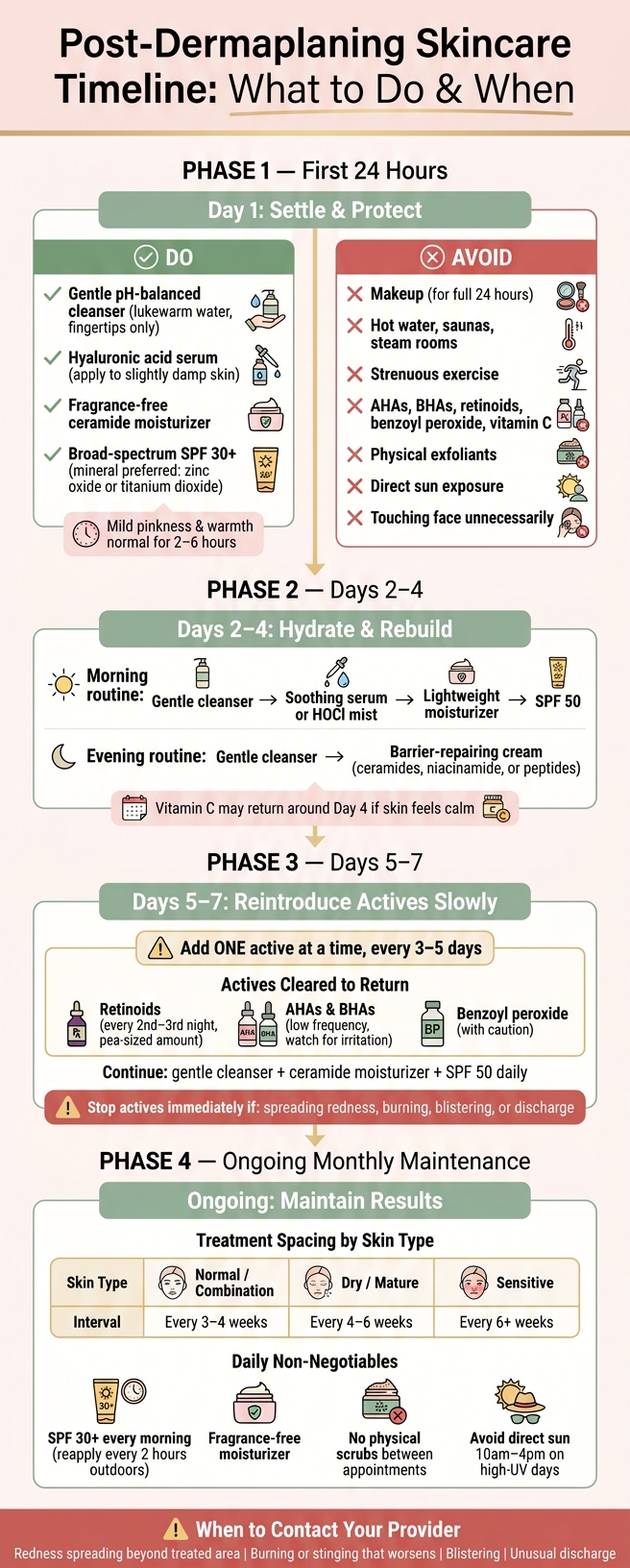
Post-Dermaplaning Skincare Timeline: What to Do & When
Day 1 Care
The first 24 hours after dermaplaning matter most for skin barrier recovery. Dermaplaning removes the top layer of dead skin cells and peach fuzz, so your skin is more exposed for a short time.
Cleanse, Hydrate, and Protect the Skin Barrier
Wash your face once in the evening with a mild, pH-balanced cleanser and lukewarm water. Use your fingertips with soft circular motions, then pat your skin dry with a clean towel. Don't rub.
After that, apply a hydrating serum like hyaluronic acid while your skin is still slightly damp. Follow with a plain, fragrance-free moisturizer that contains ceramides, squalane, or glycerin. In the morning, finish with broad-spectrum SPF 30 or higher. Mineral sunscreens with zinc oxide or titanium dioxide are often easier on freshly resurfaced skin.
What to Avoid in the First 24 Hours
For the first day, keep things simple and avoid heat or strong skincare actives. That includes AHAs, BHAs, retinoids, benzoyl peroxide, and vitamin C for at least 24 to 48 hours. This helps lower the chance of stinging and micro-flaking.
You'll also want to skip:
- Physical exfoliants
- Hot water
- Saunas and steam rooms
- Strenuous exercise for at least 24 to 48 hours
- Touching your face unless needed
- Makeup for a full 24 hours
If you have to wear makeup, use clean brushes and a light mineral formula.
| Timing | Recommended Care | What to Avoid |
|---|---|---|
| First 24 Hours | Gentle, pH-balanced cleanser; hyaluronic acid serum; ceramide moisturizer; broad-spectrum SPF 30 or higher in the morning | Makeup, exercise, hot water, saunas, direct sun, all active acids and retinoids |
Mild pinkness, warmth, and tightness can last two to six hours. If redness or stinging gets worse, give your skin more time before you start using actives again.
After the first 24 hours, keep your routine minimal and bring products back one at a time.
sbb-itb-c911f39
Week 1 Care
Week 1 is when the focus moves from settling the skin to helping it rebuild. From day 2 to day 7, keep things centred on hydration and barrier support. This is NOT the week to test new products or pile on actives. The skin needs a calm, steady routine.
A Simple Morning and Evening Routine for Week 1
Use the same gentle cleanser morning and night. What changes is the support you add after cleansing.
In the morning, the job is protection. Cleanse with lukewarm water and a mild, fragrance-free cleanser. Then apply a lightweight hydrating serum or moisturizer. Finish with a broad-spectrum SPF 50 every day, even when it’s cloudy or when you’ll be indoors near windows, since UV exposure can add to post-inflammatory hyperpigmentation on freshly treated skin.
At night, shift to repair. Cleanse with the same gentle cleanser, then apply a richer, fragrance-free moisturizer with ceramides, niacinamide, or peptides to help support the skin barrier while you sleep. A hypochlorous acid (HOCl) mist may also help settle redness without stinging.
| Step | Morning | Evening |
|---|---|---|
| Cleanse | Mild, fragrance-free cleanser | Mild, fragrance-free cleanser |
| Treat | HOCl mist or soothing serum | Barrier-repairing lipids or peptides |
| Hydrate | Lightweight moisturizer | Rich, nourishing cream |
| Protect | SPF 50 (essential) | Not applicable |
How to Reintroduce Products and Watch for Irritation
Once your skin feels calm, you can start adding products back in slowly. Dermaplaning can make skin absorb products more easily for a short time, so actives may sting faster than they normally would. Wait 5 to 7 days before bringing back retinoids, AHAs, BHAs, and benzoyl peroxide. Vitamin C can come back around day 4, but only if the skin feels calm. After that, add just one product at a time every 3 to 5 days.
Some mild tightness, slight dryness, and a bit of flaking can happen during this week. That part isn’t unusual. Stop actives and contact your provider if redness starts spreading, burning gets worse, or you notice blistering or discharge.
Monthly Upkeep
After the first week, the aim is simple: keep your results going without upsetting your skin. Once things have settled down, the focus moves from recovery to maintenance.
Keep the Routine Simple Between Appointments
Between appointments, stick to three basics: a fragrance-free, pH-balanced gentle cleanser, a moisturiser that fits your skin type, and broad-spectrum SPF 30 or higher every morning.
Apply your hydrating serum while your skin is still slightly damp after cleansing. That small step can help lock in moisture. Ingredients like hyaluronic acid, ceramides, squalane, and glycerin can help reduce dryness between appointments.
How to Add Actives Back Without Over-Exfoliating
Once your skin is calm, bring actives back slowly. Dermaplaning can increase product absorption, so even products your skin already knows can hit a bit harder after treatment. A good rule is to add one active at a time every 3 to 5 days, and use it less often than you normally would.
Start retinoids every second or third night, using a pea-sized amount. For AHAs, BHAs, and vitamin C, take the same slow approach and watch closely for signs of irritation. Skip physical scrubs and exfoliating brushes altogether between appointments.
Between appointments, keep your attention on hydration, barrier support, and very little exfoliation. Daily SPF stays non-negotiable, especially if you'll be outside.
Sun Care After Dermaplaning
Once your skin has settled, daily sun protection becomes the main habit that helps keep your results looking good. Dermaplaning removes the outermost layer of dead skin cells and vellus hair, which leaves skin more open to UV exposure and irritation. So this isn’t a one-off step. It’s the day-to-day upkeep that helps maintain comfort and results between appointments.
In Canada, that matters all year, not just in summer.
Apply SPF Daily and Reapply During Outdoor Exposure
Apply a broad-spectrum SPF 30+ every morning as the last step in your routine, using gentle strokes. If your skin feels a bit sensitive, use a mineral SPF for the first 48 hours. After that, you can move to any broad-spectrum formula that doesn’t sting.
For the first 48 to 72 hours after treatment, stay out of direct sun. If you’ll be outside for a longer stretch, reapply sunscreen every two hours, or right after sweating.
Adjusting Sun Protection for Canadian Weather
Canadian weather can be sneaky. Snow reflects UV rays and can make exposure stronger, so daily SPF still matters on cold days. And if you commute in places like Toronto, Montreal, or Calgary, you’re still getting UV exposure through car windshields and windows.
In Ontario and Quebec summers, it’s smart to avoid direct sun from 10 a.m. to 4 p.m., when UV rays are strongest. If someone is planning a trip with high UV exposure, book dermaplaning at least one week before departure so the skin has time to settle. A wide-brimmed hat also gives you a layer of physical protection that sunscreen on its own can’t fully replace during high-exposure periods.
With UV protection handled, the next thing to look at is how often to repeat the treatment.
Treatment Spacing and Client Expectations
Once the skin has settled, dermaplaning should only be repeated as often as the skin can bounce back with ease. The best timing for the next visit comes down to two things: skin type and how long recovery takes.
Recommended Spacing by Skin Type
Normal/combination skin often does well every 3 to 4 weeks. Dry or mature skin usually needs 4 to 6 weeks. Sensitive skin often needs 6+ weeks to help cut down irritation and barrier stress.
| Skin Type | Recommended Interval | Primary Focus |
|---|---|---|
| Normal/combination | 3–4 weeks | Maintaining smooth, consistent results |
| Dry / Mature | 4–6 weeks | Supporting barrier recovery |
| Sensitive | 6+ weeks | Minimising inflammation and barrier disruption |
Use the shortest interval only when the skin is calm and free of irritation.
If a client uses active skincare, timing matters here too. Retinoids, AHAs, and BHAs should be stopped 3 to 5 days before treatment and held for 7 days after.
How to Standardise Post-Care Instructions for Better Client Compliance
For clinics, the same interval should show up in both booking notes and aftercare instructions. That small bit of consistency helps avoid mix-ups later.
Written aftercare should cover:
- the first 72 hours of sensitivity
- the 7-day no-actives rule in every handout
- a simple guide to normal versus concerning reactions
Written informed consent forms can also help set expectations by outlining the risks and benefits before treatment starts. Clinics that use automated SMS or email follow-ups right after the appointment tend to get better compliance, because clients receive reminders at the moment they need them.
Send written aftercare right after treatment, then follow up within 24 hours by text or email. Record the products used, the skin reaction, and the next suggested interval. Document products used, reactions, and spacing so the next session lines up with the client's actual response. Clear aftercare notes make long-term maintenance easier for both client and provider.
Conclusion
Long-term results usually come down to simple, steady aftercare. For the first 24 to 48 hours, keep things bare-bones: use a gentle cleanser, a fragrance-free moisturiser, and SPF 30+. Skip makeup and active ingredients at the start, then bring them back slowly once your skin feels calm. From there, a barrier-first routine with ingredients like hyaluronic acid and ceramides can help support the skin between appointments. Simple daily care, careful product timing, and steady SPF use can help one treatment last longer.
Sun protection is not optional after dermaplaning. SPF 30+ stays non-negotiable if you want to protect your results and help prevent hyperpigmentation. For clinics, clear aftercare guidance makes those habits easier to stick with between appointments. For best results, pair day-to-day care with treatment spacing based on skin type and sensitivity.
FAQs
How do I know when my skin is ready for actives again?
Your skin is usually ready once the early sensitivity has calmed down. Any mild redness or tingling should ease off within about 2–6 hours. If the redness sticks around for more than 24 hours, check with your provider.
As a general rule, avoid retinoids, AHAs, and BHAs for at least 48–72 hours. Most people can start adding these actives back in slowly around day 4, then use them with more confidence after 5–7 days. If your skin tends to react easily, the wait can be closer to 1–2 weeks.
What should I do if my skin burns or stays red after dermaplaning?
Redness or a burning feeling after dermaplaning usually means your skin is on the sensitive side. For at least 48 hours, keep your routine simple and skip retinoids, acids, vitamin C, and alcohol-based products.
Use a gentle, non-comedogenic, fragrance-free moisturiser to help your skin barrier recover. Hypochlorous acid can also help calm redness. It’s also smart to avoid heat, sweating, and direct sun, and to wear sunscreen.
Can I wear sunscreen and makeup the same day after treatment?
Yes, but put sunscreen first and hold off on makeup for a bit.
Use a broad-spectrum mineral sunscreen with SPF 30 or higher right after treatment and again every morning after that.
As for makeup, wait at least 24 hours. When you start wearing it again, go with gentle, non-comedogenic, mineral-based products. It also helps to use clean brushes or sponges so you don’t irritate your skin.