

Chemical peels are powerful tools for skin renewal, but their effectiveness hinges on matching the right peel to your skin type. Here's what you need to know:
- Peel Types: Light peels target fine lines and uneven tone; medium peels address age spots and scars; deep peels tackle severe wrinkles but come with longer recovery.
- Skin Types: Oily skin benefits from salicylic acid; dry skin responds well to lactic acid; sensitive skin prefers mandelic acid; glycolic acid suits normal or aging skin.
- Fitzpatrick Scale: Skin tones range from I (fair) to VI (dark). Darker tones (IV-VI) require gentler peels to avoid pigmentation issues.
- Safety First: Pre-treatment routines, post-care, and avoiding contraindications (like recent isotretinoin use) are essential for safe results.
Quick Tip: Always consult a skincare professional to evaluate your skin type, tone, and medical history before starting any peel treatment.
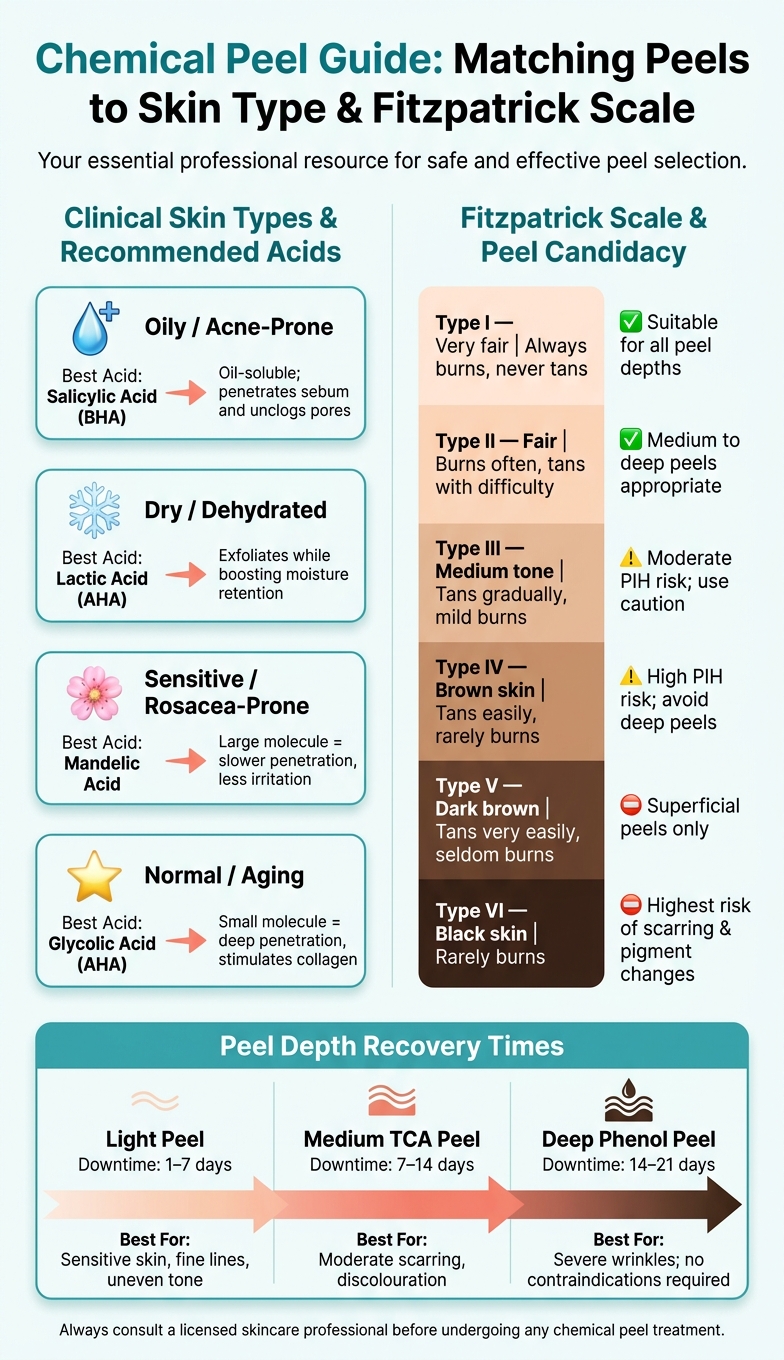
Chemical Peel Guide: Skin Type & Fitzpatrick Scale Matching Chart
Dermatologst's Guide To Chemical Peels | Doctorly Explains
sbb-itb-c911f39
Skin Type Classifications and How They Affect Peels
When choosing a chemical peel, skincare professionals rely on two key frameworks: clinical skin type (how the skin behaves daily) and Fitzpatrick phototype (how the skin reacts to UV exposure and potential injury). These classifications are the foundation for determining the right acid and peel depth for each client.
Clinical Skin Types
Each skin type reacts differently to chemical peels, so selecting the right acid is essential.
- Oily and acne-prone skin: Beta-Hydroxy Acids (BHAs) like salicylic acid are ideal. BHAs are oil-soluble, allowing them to penetrate sebum and clear clogged pores more effectively than water-soluble Alpha-Hydroxy Acids (AHAs).
- Dry or dehydrated skin: Lactic acid, an AHA, is a great option. It exfoliates while also enhancing the skin's natural moisture retention.
- Sensitive or rosacea-prone skin: Mandelic acid works well here. Its larger molecular structure slows penetration, reducing irritation while still clearing pores and calming redness.
- Normal and aging skin: Glycolic acid is a versatile choice. Its small molecular size allows it to penetrate deeply, stimulate collagen production, and improve skin firmness.
Fitzpatrick Skin Phototypes 1 Through 6
In addition to clinical behaviour, the Fitzpatrick scale helps predict how skin responds to sun exposure and its risk of post-inflammatory hyperpigmentation (PIH). Developed in 1975 by Dr. Thomas Fitzpatrick, this scale remains a trusted tool for assessing melanin levels and sun sensitivity.
| Fitzpatrick Type | Skin Characteristics | Sun Reaction | Peel Candidacy |
|---|---|---|---|
| Type I | Very fair, blue eyes, freckles | Always burns, never tans | Suitable for all depths |
| Type II | Fair skin, light hair | Burns often, tans with difficulty | Appropriate for medium to deep peels |
| Type III | Medium tone | Tans gradually, mild burns | Moderate PIH risk; caution needed |
| Type IV | Brown skin | Tans easily, rarely burns | High PIH risk; avoid deep peels |
| Type V | Dark brown skin | Tans very easily, seldom burns | Superficial peels only |
| Type VI | Black skin | Rarely burns | Highest risk of scarring and pigment changes |
For Fitzpatrick Types IV through VI, deep peels are generally avoided due to the risk of permanent hypopigmentation - a condition where the skin lightens irreversibly. Instead, mandelic and salicylic acids are preferred for their controlled, superficial exfoliation that minimizes melanin production.
"Deeper peels carry significantly higher PIH risk for Fitzpatrick Types IV, V, and VI. This doesn't mean darker skin tones can't benefit from peels - it means the approach must be different, more conservative, and carefully staged." - Skin Spa Editorial Team
For clients with Type III skin, a pre-treatment protocol lasting 4–6 weeks can help prepare the skin. This regimen often includes retinoids or melanin-inhibiting agents like kojic acid or hydroquinone, making medium-depth peels safer.
Other Skin Factors to Consider
Beyond clinical and Fitzpatrick assessments, other factors help ensure peels are both safe and effective.
- Medication history: Clients who have used isotretinoin (Accutane) within the last six months should avoid chemical peels, as this drug slows wound healing and increases scarring risk. Chronic glucocorticoid use or medications that heighten skin sensitivity also require careful consideration.
- Active skin conditions: Conditions such as open lesions, active herpes simplex, psoriasis, or atopic dermatitis must be resolved before performing a peel. For clients prone to cold sores, oral antiviral medication should be prescribed at least 24 hours before the procedure to prevent reactivation.
- Lifestyle factors: Smoking can delay wound healing and increase the risk of complications. Additionally, a client’s commitment to post-treatment sun avoidance plays a critical role in recovery.
A thorough pre-treatment assessment, including these considerations, ensures both client safety and optimal results. Professionals looking to expand their expertise in advanced exfoliation can also become a trained dermaplaning professional to complement their chemical peel services.
Choosing the Right Chemical Peel for Each Skin Type
Selecting the appropriate chemical peel involves understanding both clinical skin types and Fitzpatrick phototypes. This personalized approach ensures treatments are effective and safe. Since each skin type has unique needs, matching the right acid to those needs is crucial for achieving great results while minimizing risks.
Oily and Acne-Prone Skin
Salicylic acid is particularly effective for oily and acne-prone skin, targeting sebum trapped in clogged pores. Professional-grade concentrations range from 10% to 30%, far stronger than the 1%–5% found in over-the-counter products.
"Salicylic acid is a beta hydroxy acid (BHA). It is highly lipophilic (attracted to lipids/oils) which allows it to concentrate in sebaceous (oil) glands." - Nazanin Kalani Williams, MD, Elevation Dermatology
For active acne, a series of 4–6 treatments spaced 2–4 weeks apart is recommended. Expect mild redness or flaking for up to seven days after each session. Once acne is under control, glycolic acid peels can be introduced to address post-inflammatory hyperpigmentation and refine skin texture. Always screen for aspirin or salicylate allergies, and advise clients to pause topical retinoids several days before each treatment.
Next, let’s look at how to approach dry or dehydrated skin.
Dry or Dehydrated Skin
Gentle exfoliation is key for dry or dehydrated skin to avoid disrupting the skin barrier. Lactic acid is a great starting point; derived from milk, it exfoliates while maintaining hydration.
"Derived from milk, the lactic peel is ideal for skin that's dry or sensitive to active ingredients like retinol." - Epiphany Dermatology
For more pronounced texture concerns, a low-strength glycolic peel may be an option. Glycolic acid penetrates deeply, removing dead skin cells while still retaining moisture. Post-treatment, skin may flake and renew for 7–10 days. Clients should avoid harsh active ingredients for 10–14 days after the peel.
Sensitive or Reactive Skin
Sensitive or reactive skin requires a cautious approach to avoid irritation while still achieving exfoliation. Superficial AHA peels are the safest choice, with mandelic acid being particularly suitable due to its larger molecular structure, which slows penetration. A pre-treatment conditioning period of 2–4 weeks with gentle, barrier-supportive skincare can further enhance results.
Patch testing the peel on a discreet area (like behind the ear or inner wrist) and monitoring the skin for 24–48 hours is essential. During the peel, using a fan can help reduce discomfort. After treatment, applying barrier-repairing ingredients like Centella Asiatica or allantoin promotes skin recovery.
For clients with both sensitive and oily areas, a multi-zone approach works best, as outlined below.
Combination Skin
Combination skin benefits from a tailored strategy to address its varied needs. For oilier areas like the T-zone, salicylic acid works well, while drier areas respond better to lactic acid. Blended formulations can also balance the skin’s needs while minimizing irritation.
Normal and Resilient Skin
Normal skin is generally more tolerant, offering flexibility in peel choices. Glycolic acid is an excellent option for overall skin rejuvenation, thanks to its small molecular size, which allows it to penetrate deeply and improve firmness and brightness. For clients seeking added benefits like brightening or antioxidant effects, AHA and vitamin C combination peels can help reduce dullness, refine pores, and diminish the appearance of age spots. These peels are typically well-tolerated, making them suitable for regular maintenance treatments.
Safety and Best Practices for Chemical Peels
Contraindications and Risks
Not everyone is suited for a chemical peel, which is why identifying potential risks and contraindications early is crucial for safe and effective treatments.
"A thorough client intake and skin analysis are essential to avoid adverse reactions such as burns, scarring, or post-inflammatory hyperpigmentation (PIH)." - Erica Roybal, Founder, Elite Aesthetics Academy
Some conditions require a complete halt on treatment. Absolute contraindications include active herpes simplex, open wounds, allergies to peeling agents, and current isotretinoin use. Clients using isotretinoin must discontinue it for at least 6 to 12 months before undergoing medium or deep peels.
Relative contraindications, on the other hand, may allow for treatment with adjusted protocols. These include factors like Fitzpatrick skin types IV–VI, pregnancy, recent sun exposure, autoimmune disorders, and inflammatory skin conditions like eczema or psoriasis. Medications such as doxycycline or minocycline, which increase photosensitivity, should also be flagged during intake to prevent pigmentation issues. For deeper peels involving phenol, cardiac monitoring is recommended due to the potential for arrhythmias if applied too quickly.
The table below outlines contraindication categories and the recommended professional actions:
| Category | Examples | Action |
|---|---|---|
| Absolute | Active herpes simplex, open wounds, isotretinoin use | Deny treatment until resolved or waiting period is met |
| Relative | Fitzpatrick IV–VI, pregnancy, autoimmune disorders | Modify peel strength; require physician clearance or skin priming |
| Procedural | Recent waxing, laser treatments, or facial surgery | Defer treatment until skin integrity is fully restored |
Once contraindications are addressed, effective pre-treatment preparation becomes the next step to ensure a safe and predictable outcome.
Pre-Treatment Preparation
Proper skin preparation is essential to achieving consistent results and smooth recovery. Conditioning the skin beforehand helps it respond more evenly to the peel and reduces the risk of complications.
"The goal of chemical peeling is to remove a predictable uniform thickness of damaged skin. Normal wound healing and skin rejuvenation follow, while complications such as scarring and pigmentary changes are minimized." - Gabriella Fabbrocini, MBBS, MD, Professor in Cutaneous and Venereal Diseases
For clients with Fitzpatrick types I–III, a two-week preparation period is generally enough. This includes gentle cleansing, consistent hydration, and daily use of broad-spectrum sunscreen with professional facial supplies. For Fitzpatrick types IV–VI, preparation should extend to 4–6 weeks and include barrier-repair products and a 2%–4% hydroquinone cream to lower the risk of PIH. A priming routine with topical tretinoin (0.025%–0.05%) or AHAs (5%–10%) can also help thin the outermost layer of skin, improving peel penetration.
Certain products must be paused before treatment:
- Retinol: Stop 14 days prior
- Tazarotene: Stop 21 days prior
- AHAs/BHAs: Stop 2–3 weeks prior
For new clients or those prone to sensitivities, a patch test 72 hours before the full treatment is recommended. In Canada, scheduling peels during fall or winter is ideal, as reduced UV exposure during these seasons helps minimize sun-related complications during recovery.
Once the skin is properly prepped, post-treatment care becomes the focus to protect and enhance the results.
Post-Treatment Care
The recovery phase is just as important as the peel itself. Following proper aftercare ensures the skin heals well and the desired results are achieved.
"The way you treat your skin post-peel - keeping it protected, hydrated, and hands-off - is just as important as the treatment itself." - DermaQuest
For the first 8–24 hours, avoid washing or applying any products to allow the peel to settle. After this period, use a gentle cleanser and hydrating serum, but hold off on active ingredients like AHAs, BHAs, and retinoids until sensitivity subsides, usually around day seven. Daily application of a broad-spectrum mineral SPF 30 is essential, with reapplication every two hours when outdoors. Adding a hat for extra protection is a smart move.
Resist the urge to pick at peeling skin, as this can lead to scarring or infection. Avoid heat sources such as saunas, hot showers, and strenuous exercise for at least 48 hours post-treatment. If symptoms like burning, severe itching, swelling, blistering, or prolonged frosting persist beyond 48 hours, seek medical attention immediately. Additionally, wait at least two weeks before scheduling any follow-up procedures like fillers or injectables.
Proper post-peel care is key to ensuring the treatment’s success and minimizing risks. By following these guidelines, both clients and practitioners can achieve the best possible outcomes.
Combining Dermaplaning With Chemical Peels
Benefits of Pairing Dermaplaning With Peels
Dermaplaning and chemical peels each bring their own benefits, but when used together, they can deliver even better results. Dermaplaning works by exfoliating the skin mechanically, removing vellus hair and surface buildup. This process creates a smooth surface that allows chemical peel solutions to absorb more evenly and deeply into the skin.
"Dermaplaning removes surface buildup, allowing acids to penetrate more evenly." - Esthetician Training Biz
One advantage of this pairing is that professionals can achieve noticeable improvements using milder acid concentrations - like 10–20% lactic acid. This approach reduces the risk of irritation while still improving skin texture and radiance. It’s important to tailor the treatment to each individual’s skin type and history for the best results.
Adjusting the Combined Treatment by Skin Type
Customizing the treatment sequence based on a client’s skin type and treatment history is essential. Start by conducting separate dermaplaning and peel sessions spaced 2–4 weeks apart. This helps establish how the client’s skin responds to each treatment before combining them.
"Once you have established a baseline for each treatment, they may be combined. You'll find that following dermaplaning, the peel solution will reach clinical end points sooner." - Rikki, Founder & CEO, DermaplanePro
Because dermaplaning thins the stratum corneum, the skin becomes more sensitive to acids. This means the peel should be neutralized sooner than usual, and client feedback on sensation (keeping heat levels at or below 6/10) should be closely monitored. For multiple-layer peels, fewer layers are often necessary to reach the desired endpoint.
For sensitive or reactive skin, a "split stack" approach is ideal. Perform dermaplaning in one session and schedule the chemical peel about a week later to avoid overwhelming the skin barrier. For clients with Fitzpatrick skin types IV–VI, always conduct a patch test and opt for low-strength acids to reduce the risk of post-inflammatory hyperpigmentation. Clients with conditions like active acne, severe rosacea, eczema, or a compromised barrier should avoid combined treatments.
Adding red or near-infrared LED therapy for 10–15 minutes after the peel can help reduce inflammation and promote healing. However, avoid blue LED therapy immediately post-peel if the skin barrier appears stressed.
Professional Tools and Supplies
To ensure safe and effective treatments, the right tools are critical. Always perform dermaplaning before the chemical peel, as this prepares the skin for better absorption of the peel. Using professional blades, such as the #10R or #14, ensures proper and comfortable skin preparation.
When applying the chemical peel, essential tools include gauze, cotton swabs, brushes, and stainless steel bowls for holding the solution. A degreasing step using 70% isopropyl alcohol before dermaplaning is also key for removing oils and creating a clean surface.
For Canadian professionals, Dermaplaning Supplies Canada offers a range of products tailored to clinic use. Their inventory includes sterile surgical-grade blades (starting at $12.95 CAD) and post-treatment jelly masks for hydration (starting at $1.95 CAD). They also provide online training certification that covers protocols for combining dermaplaning with other treatments. Using high-quality supplies ensures both safety and optimal results for clients.
Key Takeaways for Skincare Professionals
Choosing the right peel for each skin type is the starting point for a safe and effective treatment. Salicylic acid is ideal for oily and acne-prone skin due to its oil-soluble nature, allowing it to penetrate clogged pores. On the other hand, glycolic acid is better suited for dry skin, as it exfoliates while helping to retain moisture. For those with combination skin, Jessner's solution - a mix of lactic acid, salicylic acid, and resorcinol - addresses both oily zones and uneven texture in one treatment. A solid understanding of how different acids work naturally leads to selecting the appropriate peel depth.
Peel depth should align with the client’s skin concerns and tolerance levels:
- Light peels: Minimal downtime (1–7 days) and suitable for sensitive skin.
- Medium TCA peels: Require 7–14 days of recovery and work well for moderate scarring or discolouration.
- Deep phenol peels: Involve significant downtime (14–21 days) and should only be used for clients without contraindications who can manage the extended healing period.
"A comprehensive understanding of appropriate patient selection, peel choice, and contraindications, as well as associated risks and potential complications, is imperative before administering chemical peels to individuals." - StatPearls
Don’t overlook pre-treatment preparation. A 2–4-week priming regimen using low-strength actives can enhance peel results and speed up recovery. For clients with Fitzpatrick skin types III–VI, incorporating 2%–4% hydroquinone before and after the procedure can help lower the risk of post-inflammatory hyperpigmentation.
Using professional-grade tools is essential for both safety and results. Gauze sponges are a good choice for liquid peel solutions, as their texture improves penetration. Brushes or cotton-tipped applicators allow for precise application when needed. Always keep a neutralizing agent nearby for peels that don’t self-neutralize. Above all, expert consultation is key to ensuring an efficient and effective chemical peel process.
FAQs
How can I determine my Fitzpatrick skin type at home?
To figure out your Fitzpatrick skin type at home, start by observing how your skin responds to sun exposure. If your skin tends to burn easily and doesn’t tan, you likely fall into the lighter categories (Type I or II). Your natural skin tone is another key factor to consider. Additionally, features like hair and eye colour can offer hints - people with red or blond hair and blue or green eyes often have lighter skin types.
What’s the safest peel option for darker skin tones (Types IV–VI)?
Chemical peels for darker skin tones (Fitzpatrick Types IV–VI) must be selected and applied with care to minimize the chances of hyperpigmentation or inflammation. Using protocols specifically tailored for these skin types ensures both safety and effective outcomes.
How long should I wait after isotretinoin before getting a peel?
It’s typically advised to wait 5–6 months after completing isotretinoin treatment before undergoing a chemical peel. This waiting period allows your skin to recover and reduces the chances of abnormal wound healing or scarring. That said, some recent studies indicate this delay might not always be required. To make the best decision for your skin, it’s essential to consult a skincare professional who can assess your individual needs and guide you accordingly.