

If you’re solo, start small. If you’re booking steady volume across more than one room, buy for scale. That’s the short answer.
I’d break it down like this:
- A starter kit keeps the upfront spend lower, with prices like $59.99 CAD for 100 blades or about $159.95 CAD for a more complete setup.
- A pro kit or bulk bundle costs more at the start, but blade cost can drop to $1.00 CAD each at 500 units and $0.90 CAD each at 1,000 units.
- Starter kits usually focus on one blade type and lighter product stock.
- Pro kits usually include more blade options such as #10, #10R, and #14, plus more room-ready supplies and larger disposal containers.
- For treatment math, a starter setup lands at about $1.60 CAD per treatment before skincare, while full service cost often falls in the $3 to $7 CAD range once blades, prep, skincare, and PPE are included.
- The main things to compare are upfront cost, blade count, skincare included, refill timing, and room count.
If I were choosing, I’d keep it simple: a starter kit suits a new solo service launch, while a pro setup makes more sense when stock turnover, staff use, and multi-room consistency start to matter.
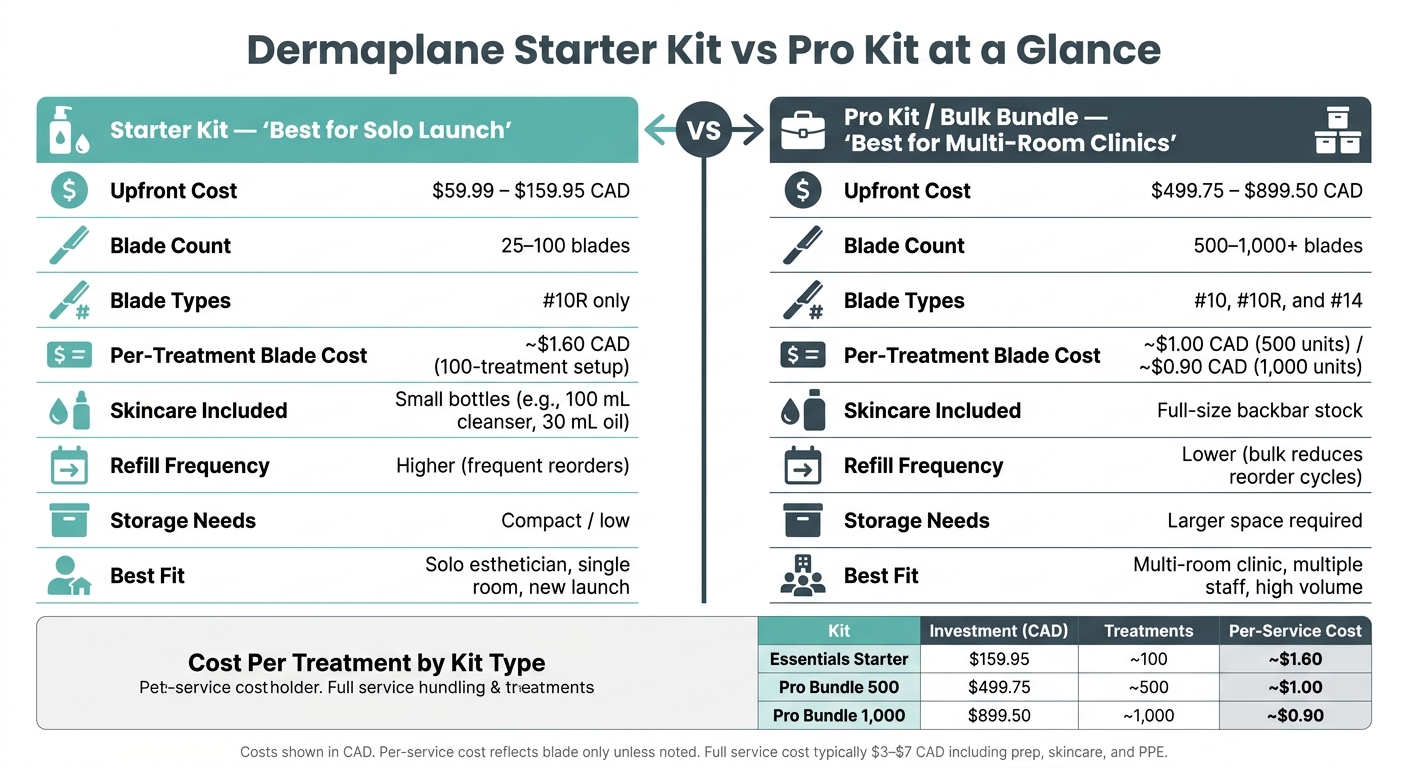
Dermaplane Starter Kit vs Pro Kit: Cost & Features Compared
Quick Comparison
| Criteria | Starter Kit | Pro Kit / Bulk Bundle |
|---|---|---|
| Best fit | Solo esthetician, single room, lower booking volume | Multi-room clinic, more staff, higher booking volume |
| Upfront cost | Lower, such as $59.99 CAD to $159.95 CAD | Higher, such as $499.75 CAD to $899.50 CAD |
| Blade count | Usually 25 to 100 | Usually 500 to 1,000+ |
| Blade types | Often centred on #10R | Usually #10, #10R, and #14 |
| Skincare included | Light stock, smaller bottles | More backbar stock, full-size items in many kits |
| Per-treatment blade cost | About $1.60 CAD in a 100-treatment setup | About $1.00 CAD at 500 or $0.90 CAD at 1,000 |
| Refill frequency | Higher | Lower |
| Storage needs | Lower | Higher |
So if you want the plain answer: starter kits suit low-risk setup; pro kits suit volume. The rest of the article helps match that choice to your booking pace, treatment rooms, and restock cycle.
sbb-itb-c911f39
Starter kit contents and treatment capacity
A starter kit gives you the basics you need to offer safe, professional dermaplaning without loading up on a lot of inventory at the start.
Core tools and blades in a starter kit
At the centre of the kit is a #3 stainless steel scalpel handle. That's the standard handle used with the #10, #10R, and #14 blades for professional dermaplaning. Most starter kits focus on the #10R "Butter Blade", which has a rounded safety edge. That makes it a solid choice for sensitive skin and general exfoliation.
A standard starter kit comes with 100 blades. Since each blade is single-use, that works out to about 100 treatments. You'll also need a blade removal box or sharps container, and most kits include one. Along with the blades, it's common to get 100 alcohol prep pads and 100 post-treatment care cards, matched to the blade count on a one-to-one basis.
That simple setup makes sense when you're starting small. Once your booking volume picks up, that's usually when a pro kit starts to make more sense.
Prep, finishing care, and backbar basics
The skincare side of a starter kit is kept pretty light. You can usually expect small bottles, such as a 100 mL cleansing gel or a 30 mL (1 fl. oz.) nourishing oil, which is enough for your first round of appointments.
Full-size SPF, toners, jelly masks, and specialty serums are usually not included. If you want to build out the service or add more finishing steps, you'll need to buy those items separately.
Best fit for a solo launch and post-certification setup
A complete starter kit priced at $159.95 CAD includes the handle, 100 #10R blades, a blade removal box, alcohol prep pads, and post-care cards. For a newly certified esthetician, that's enough to start booking clients right away. The lower upfront spend helps keep risk in check while you build your client list and get more comfortable with your treatment flow.
This setup is a good fit for a home studio or a single-room spa that wants to add dermaplaning to an current menu. Inventory stays lean, reordering is simple, and the 100-treatment capacity gives you room to grow before you need to restock. In most cases, the first items to run low are alcohol prep pads, blades, and post-care cards, because each one is used at a 1:1 ratio per client. As bookings grow, refill timing and room supply needs usually become the next main cost factor.
Pro kit contents, room setup, and clinic readiness
As booking volume grows, the focus changes. It’s no longer just about the upfront price. It becomes about room efficiency, refill speed, and how smoothly the clinic runs day after day.
A pro kit is built for that next stage. While a starter kit for students handles launch needs, a pro kit is meant for higher volume, a broader range of skin types, and faster room turnover. It gives clinics more blade choices and full-room supplies that can keep up with repeated daily use.
Higher blade volume and broader tool range
The biggest change is blade variety. Pro kits add #10, #10R, and #14 blades, which gives practitioners more flexibility during treatment.
Here’s where that matters:
- The #10 blade has a sharper tip, which helps with precise work around areas like the upper lip and chin.
- The #14 blade is better suited to thicker, coarser hair and skin affected by sun damage.
Disposal also gets an upgrade. Pro kits come with a larger sharps container, which makes more sense for higher-volume use.
Full-size skincare and treatment-room supplies
Pro kits also move beyond sample-size products. Instead, they include full-size backbar items for daily treatment use. That can mean full-size cleanser, oil, and finishing masks.
That kind of standard product setup helps keep treatment results steady from one appointment to the next. For room prep, use room-temperature moistened towels. Hot towels can irritate freshly dermaplaned skin. A towel warmer can still help here by keeping pre-moistened towels ready at a comfortable temperature.
This matters even more in clinics with multiple rooms or several practitioners. When each room uses the same setup, there’s less guesswork and fewer inconsistencies.
Best fit for multi-room clinics with consistent bookings
For clinics with more than one room or practitioner, a pro kit makes it easier to standardise protocols. Everyone works from the same blade types, prep products, and aftercare steps, which helps keep results steady from room to room.
Pro kits also support heavier booking volume because they come with larger blade quantities. Bulk bundles can include 500 blades for $499.75 CAD or 1,000 blades for $899.50 CAD. At that point, inventory affects more than convenience. It also changes refill timing and cost per treatment.
From there, the next step is looking at how blade volume affects restocking and per-treatment cost.
Cost per treatment and refill planning
Upfront price matters, but cost per treatment and how often you need to reorder tell you much more. The main comparison isn’t the sticker price. It’s how each kit holds up across day-to-day appointments.
How starter kit costs add up over time
The Essentials Starter Kit costs $159.95 CAD and supports about 100 treatments. That works out to about $1.60 per treatment before skincare.
For someone starting out solo, that price can look pretty appealing. But there’s a catch. Once your booking volume climbs, smaller reorders can push overhead up.
That lower buy-in works well at first, right up until appointment volume starts forcing more frequent reorders.
How pro kits can lower unit costs at volume
This is where bulk pricing starts to make more sense. A 500-count bundle costs $499.75 CAD, or $1.00 per blade, while a 1,000-count bundle costs $899.50 CAD, or $0.90 per blade.
Once you add blades, prep, finishing skincare, and PPE, the usual cost per service lands around $3 to $7 CAD. So even though the upfront spend is higher, the per-service math often gets better as volume grows.
Here’s how that plays out across kit types:
| Kit Type | Upfront Investment (CAD) | Treatments Supported | Per-Service Cost | Refill Frequency | Best Use |
|---|---|---|---|---|---|
| Essentials Starter Kit | $159.95 | ~100 | ~$1.60 (blade, prep, cards) | Higher | Solo launch |
| Pro/Bulk Bundle (500 blades) | $499.75 | ~500 | ~$1.00 (blade only) | Lower | Growing clinic |
| Pro/Bulk Bundle (1,000 blades) | $899.50 | ~1,000 | ~$0.90 (blade only) | Lowest | Multi-room clinic |
At higher volume, the next thing to watch is simple: what runs out first, and how often.
What to restock first in a Canadian practice
Blades come first - every service should use a fresh, sterile blade. After that, keep a close eye on sharps containers and blade remover boxes, since they need to be replaced once they hit the fill line.
Alcohol prep pads tend to move at a steady pace as bookings increase. Backbar products like cleanser, oil, and serum also need regular reordering once full-size stock is used up.
For clinics going through supplies at a steady clip, buying in larger quantities can help. Ordering 10 or more of the same item can unlock a 10% bulk discount, which can help multi-room clinics keep refill costs in check.
In practice, refill planning is a pretty clear signal. It shows whether a kit fits a solo setup or a clinic with full days and multiple treatment rooms.
Which kit fits your business model
Once refill costs and room demand are clear, your business model usually makes the call. The right kit depends on appointment volume, team size, and how much storage space you have.
Best choice for a solo esthetician
If you're adding dermaplaning for the first time or working out of a single treatment room, the Essentials Starter Kit at $159.95 CAD is the leanest place to start. It keeps upfront costs and storage needs low while you test demand.
Best choice for a multi-room clinic
If you run more than one room or have multiple practitioners doing treatments, a starter kit can start to feel limiting. Bulk bundles - starting at $499.75 CAD for 500 blades - make it easier to keep each room stocked with the same blade types, whether you use a #10R or #10 blade sampler for sensitive skin or the #14 for thicker, sun-damaged skin. They also help keep blades, prep, and aftercare in one system.
Use the same criteria below to match the kit to your practice.
| Feature | Starter Kit | Pro Kit / Bulk Bundle |
|---|---|---|
| Ideal fit | Solo launch, single suite, low volume | Multi-room clinic, high volume, multiple staff |
| Main advantages | Low entry cost, compact storage, training support in some bundles | Lower cost per treatment, standardised setup, bulk savings |
| Trade-offs | Higher unit cost, more frequent restocking at volume | Higher upfront spend, more storage space required |
| Scaling potential | Limited to individual capacity | High; supports multiple rooms and practitioners |
| Blades included | 25–100 blades | 500–1,000+ blades |
Conclusion and key takeaways
The right kit comes down to how your practice runs today. A starter kit makes sense for a solo launch. A pro-level bulk bundle fits a clinic with steady bookings and more than one treatment room. As volume climbs, the gap in per-treatment cost gets harder to brush off.
Dermaplaning Supplies Canada carries professional blades, starter kits, skincare, facial supplies, and online training certification for skincare professionals. For Canadian providers, the best fit is the kit that lines up with current volume, room count, and restock cadence.
FAQs
When should I upgrade to a pro kit?
Move up to a professional kit when you’re ready to standardize treatment protocols, tighten up your workflow, and deliver consistent, repeatable results across your practice.
It also makes sense when you need one clear system that brings together specialized blades, handles, prep products, and aftercare in a single package. That can make inventory a lot easier to manage as your client base grows.
Which blade type is best for my clients?
The best blade comes down to your client’s skin type and hair texture. There isn’t a one-size-fits-all pick here.
- #10R: Best for thin, fragile skin and vellus hair. Its rounded edge gives you better control in creases and helps cut down on irritation.
- #10: Best for precise work around the mouth, upper lip, and chin. Its sharp tip works well for medium-thick hair.
- #14: Best for thicker, sun-damaged skin or coarser hair. It removes dense dead skin and thicker hair with ease.
How much storage space does a pro kit need?
Professional dermaplaning kits are built to keep things simple and efficient. They usually bring together the core items you need, like blade handles, blades, prep products, and sharps containers, in one tidy system.
That all-in-one setup makes them easy to use in a clinic. It also means they take up very little storage space and help keep the treatment area clean and organised.